Decoding the Best Beers for Spicy Foods: IPAs, Hazy, Kolsch or Stouts?
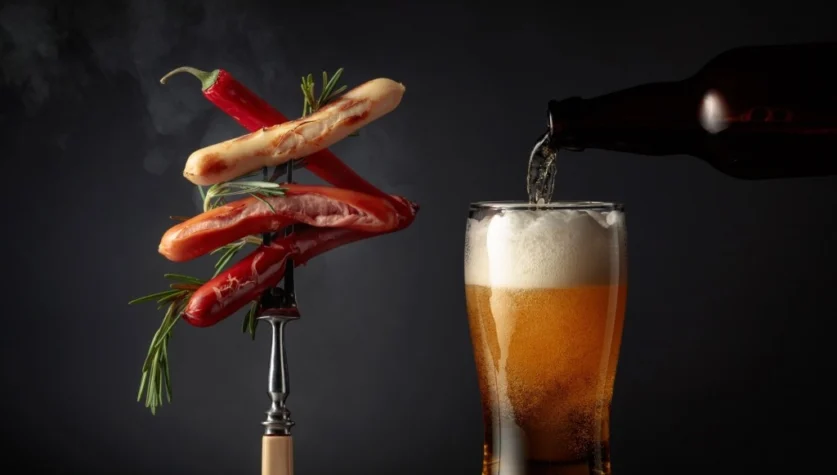
I confess, I was raised on bland meals and never nurtured a fondness for spicy food. Despite this, my spouse, kids, and companions, who enjoy spice in numerous forms, delight in provoking me to sample various dishes, usually assuring me with “It’s not excessively hot! You’ll manage.” However, I never actually do.
In my childhood, when I dared to try spiced dishes, my mother used to hand me a glass of milk to alleviate the burn I felt. I never understood why, but it seemed to do the trick. Thankfully, I found the same relief in certain beers. The right brew not only enables me to bear spicy meals but also almost savor the ordeal. And for those who already delight in the heat delivered by chili peppers, this combination is absolute perfection.
Whether you’re a spicy food veteran or a timid beginner, here are some recommendations for coupling beer with spicy meals while keeping your sanity (and hopefully without crying).
Here’s a daring suggestion: I don’t believe IPAs pair well with spicy meals. While numerous beer aficionados argue that IPAs go well with spicy dishes, they only heighten the sensation of heat. The elevated alpha acids in hops, notably prolific in IPAs, can mix with capsaicin (the active component that gives chile peppers their spiciness), forming a vicious cycle that intensifies the heat. Whether it’s the heat from habaneros or some other source, a hop-dominant beer only amplifies the spiciness.
Indeed, a cold drink provides temporary relief from the heat of spicy food. However, as your mouth warms up, the spiciness returns. This is because capsaicin, the molecule responsible for spicy heat, does not dilute in water, and beer is mostly water. Capsaicin is neutralized by fats and alcohol, explaining why milk is often recommended.
For a lasting solution, you can consider several strategies. It’s worthwhile to note that spiciness is not a flavor but a sensation, although it can combine with various flavors. Therefore, try to either pair strong with strong where suitable, or balance matching or similar tastes. Additionally, think about how sweetness or fizziness can influence the pairing.
In my experience, malt-rich and sweet beers counterbalance spiciness quite well. Therefore, I find Märzen, amber lagers, or Vienna lagers superior to IPAs. Their sweetness doesn’t conflict with the potent flavors and provides a lasting sweetness layer in your mouth.
I’d suggest pairing foods with smoky chili like chipotle or ancho with a stout, preferably one with chocolate undertones. Generally, stouts go well with hot foods. Oatmeal stouts and sweet/milk stouts are especially fitting. Oatmeal stouts derive their smoothness from the oats used in their brewing, while sweet or milk stouts are brewed with malt sugars or lactose. While not traditional milk, it neutralizes spiciness much the same. For complementing smokiness, opt for a roasted malt beer such as a brown ale.
Dark beer varieties such as black lagers, schwarzbiers, and dunkels are perfect complements to spicy dishes for several reasons, with Death and Taxes, a San Francisco-style black lager from Moonlight Brewing, being perhaps the most well-suited among them. Notably, many of such beers bear caramel undertones that further elevate their compatibility with spicy food.
Beers with high residual sugar content, including Belgian specialty ales, saisons, barley wines, and lambics, effectively neutralize the heat of capsaicins. Hazy IPAs with low bitterness also serve the same purpose.
Alternatively, some recommend countering spicy flavors with carbonated drinks. Some researchers argue that the bubbles might stimulate more pain sensors, potentially worsening the burning sensation depending on your tolerance and the spiciness of your food. However, I find bubbly drinks rather helpful in dealing with spice. If you would like to test this hypothesis, try out a Kölsch, saison, witbier, hefeweizen, biere de garde, tripel, or sparkling ale.
The art of pairing beer and food typically abides by universally accepted guidelines. However, pairing spicy food with beverages is a unique case. Some people find appeal in spicy food precisely because of the burning sensation it elicits. Thus, feel free to experiment and discover the combination that suits your preferences. If you relish the spicy thrill, opt for an IPA.
Discover America’s Rapidly Rising Canned Cocktail: Not a Seltzer but a Famed Brand of Iced Tea Vodka and Lemonades
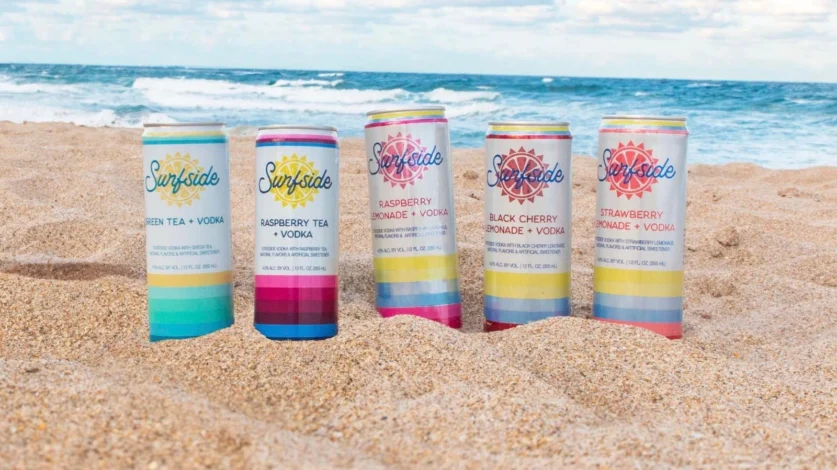
The popular brand of iced tea+vodka introduces five new flavors for summer.
It’s hardly news that ready-to-drink cocktails are all the rage. Indeed, we’ve been reporting on the trend for 5 years now. But the novel story these days is the dynamic shift within the overarching RTD category, which comprises both malt-based and spirit-based offerings. In short, the latter is growing at a far faster rate than the former. And Surfside is a brand riding these economic waters to great success.
A category leader in iced tea and lemonade-vodka RTDs, the two-year-old label is celebrating its national expansion with five new summer-friendly flavors: Raspberry Lemonade, Strawberry Lemonade, Black Cherry Lemonade, Raspberry Iced Tea and Green Tea. The fruit-forward additions join a wide stable of offerings that are all canned at 4.5% ABV, and typically retail for around $11 per 4-pack.
The independent producer behind the launch began life as part of Stateside Vodka, a Philadelphia-based distillery and cocktail lounge that still thrives in the city today. Initially the founders were canning an unflavored vodka-soda, but were compelled by acute demand for something non-sparkling.
“We realized there was a hole to fill in the RTD category,” recalls Clement Pappas, CEO of Surfside Iced Tea + Vodka. “When we were originally creating Surfside, we knew it had to taste great, be 100 calories or less and have no bubbles. Carbonated drinks can be filling and cause bloat. We also see today’s drinkers gravitate toward tasty alternatives to beer.”
Clement Pappas, CEO of Surfside Iced Tea + Vodka
Pappas’ team spent more than a year developing the taste formula. Indeed, it holds 100 calories, 2 grams of sugar and zero bubbles per 12-ounce can. It quickly emerged as a category leader, in part, because when it arrived on shelves in early 2022, there simply weren’t a lot of spirit-based hard teas and lemonades in the category. Yet the thirst was clearly there.
“We thought Surfside was a good idea or we wouldn’t have done it, but we didn’t predict just how much the brand would take off,” adds Pappas. “We grew 563% in just our second year on the market, from about 200,000 cases in 2022 to 1.3 million cases in 2023. It’s been a rocket ship of growth for us.”
Indeed, the canned cocktail segment has seen significant growth recently. While malt-based ready-to-drink (RTD) cocktails still dominate the US market in terms of volume, spirit-based RTDs are gaining ground, despite the challenges of nationwide distribution.
Based on the latest economic analysis from the Distilled Spirits Council of the United States, spirit-based RTDs held a 16% share of the total category at the end of 2023 compared to 8% in 2021. This trend suggests that today’s consumers are increasingly valuing the sophisticated elegance of alcohol-based cocktails. The expansion of Surfside further offers enthusiasts a choice of at least five more refreshing alternatives for this summer.
New additions to the Surfside range include canned iced tea and lemonade-vodka RTD cocktails.
Reviving Native Hawaiian Sugarcane: How a Scientist and Distilleries are Collaborating for Conservation

Sugarcane biodiversity disappeared as big plantations dominated the sugar trade in Hawaii, but now native varieties are making a comeback
Noa Kekuewa Lincoln remembers when he first encountered native Hawaiian sugarcane in 2004. The fresh stalks, bursting with color, might have sprouted from Willy Wonka’s imagination, not the soil.
Lincoln, a kanaka maoli (Native Hawaiian) expert in Indigenous cropping systems and an assistant professor at the University of Hawaii, said: “I grew up seeing grayish-green cane fields. But these canes are fluorescent pink, bright apple-green striped. They looked like huge cartoon candy canes. They almost don’t look real!”
Then working at the Amy BH Greenwell Ethnobotanical Garden on the Big Island of Hawaii, he saw the multicolored stalks growing, mysteriously and simply labeled “Hawaiian sugarcane”. That chance moment took Lincoln on a 20-year detour into researching Hawaii’s heirloom sugarcane varieties, neglected after centuries of plantation monoculture. Lincoln set out to identify them and “treat them like the individuals they are”.
He likens his research method to traditional navigation, “where you’re triangulating your position” in relation to known points. He interviews kupuna, or elders, in the Hawaiian community; dives into digitized archives of newspapers dating back to the 1830s; and culls information from stories, traditional medicines and chants.
A chant can offer information about how a sugarcane variety looks, where and how it grows, and its role in the ecosystem. A 19th-century chant celebrating a dignitary’s visit to Ni’ihau island is one example: “My love returns to Ni’ihau / To the hidden waters of the pao’o fish / To the breadfruit that blossoms on the flats / The sugar cane of Halali’i dug out by hand.” It gives a location (Hawaii’s westernmost island), a name for the cane variety (Halali’i) dominant there, a tip on tending the plant and its proximity to breadfruit.
Lincoln marries these sources with modern tools like DNA analysis to see relationships between varieties of sugarcane. “For cane, some of the interpretations of the chants [and oral histories] only become clear when we are out in the field doing work and observe something that helps with the interpretation. It is very rarely just one line of knowledge that helps us understand, but multiple lines of knowledge intersect,” he said.
In one case, an elder said that a particular variety of sugarcane “called” dew from the north. Lincoln only grasped the full meaning of that statement when working with sugarcane in Kona. There, he realized that the crop cast tall shadows that preserved dew on the north side of its rows. And that substantially elevated soil moisture.
Through this research, he’s uncovered 25 Hawaiian sugarcane, or kō, varieties. Halali‘i is one such variety. The name means “little hala”, or pandanus, a tree ubiquitous in the islands. Growing on windy Ni’ihau island, this sugarcane variety is frequently buried in sand so that only its top shows, resembling a small hala tree. Its other names mark how its leaves resemble sea lettuce, an edible green alga.
Many Hawaiian sugarcane varieties also share names with native fish. If the cane and the fish share similar striations or some other commonality, Hawaiians gave them the shared moniker. The black sturgeonfish, common in Hawaiian reefs, and dark purple-black canes found on Kauai are both māikoiko. maka’ā means “glowing eye” and refers to the flagtail tilefish. It possesses bright blue eyes and gray-green stripes, like an extinct sugarcane with similar gray-green stripes.
Sugarcane was originally domesticated in New Guinea around 8000 BC and brought to Hawaii as one of Polynesian voyagers’ original “canoe plants”, critical species that form the core of Hawaiian agriculture and foodways. The ancient islanders put sugarcane to various uses. Sugarcane windbreaks decrease wind damage to root crops and maintain soil moisture. Native canes provide mulch and attract nitrogen and nutrients into the soil. With those natural enhancements, Hawaiians were able to grow bigger and better sweet potatoes and taro alongside sugarcane, which itself adapted into new varieties suited to its new environs.
Though Native Hawaiians introduced sugarcane to the islands nearly a millennium before Europeans arrived, that fact often gets overshadowed in histories that focus on the impact and influence of sugarcane plantations that dominated the islands from the early 1800s onward.
Lincoln suspects that there are even more varieties, as his lab has uncovered about 80 names of traditional Hawaiian types. However, his team struggles to connect all of them to existing plants due to the colonial obliteration of both traditional knowledge and crops. By the 1840s, sugar had become a major industry in Hawaii, and an 1875 treaty allowed Hawaii to sell sugar to the United States tax-free and duty-free, ensuring substantial profits and power for its planter class.
Today, Lincoln collaborates with a businessman who used to work in Hawaii’s once-thriving sugarcane industry. Bob Gunter, president and CEO of Kōloa Rum Company, previously worked with Amfac, which was one of Hawaii’s “big five” sugar businesses, and its Lihue plantation, an early and long-standing sugarcane operation. The plantation shut down in 2000.
According to Gunter, “Hawaii was globally famous for its exceptional sugar and the concentration of its sugar. Its production levels were unheard of in other countries. The problem was that it could not compete with countries that extensively subsidize sugar or neglect to pay their workers adequately. The playing field was not level.” Kōloa, which produces its rum from granulated cane sugar, had bought tons of the ingredient from Hawaii’s plantations as they announced their closures. However, the rum maker eventually had no other choice but to source sugar from east Texas, Louisiana, and Florida.
A budding industry is now aiding in the revival of native sugarcane. Agricole rum is distilled from freshly pressed sugarcane juice, rather than molasses or granulated sugar. Kōloa and two other producers, Kuleana Rum Works and Kō Hana, conferred with Lincoln and now cultivate about 40 types of sugarcane that existed prior to western contact. Kuleana has been bottling and selling agricole rum since 2009, and Kō Hana, which began as a farm in 2009, launched its first agricole-style rum in 2014.
Gunter’s company plans to make rum from these heirloom canes, but production was delayed by the pandemic. “We’re preserving it, keeping a bank of sugarcane varieties, to perpetuate them, making sure we don’t lose them,” he said. “We’re currently at four acres and expanding to 10 to 12 acres of native cane.”
Lincoln attributes this renewed interest in kō to two movements: a larger one to reclaim Native Hawaiian identity, culture and cultivation practices, and the craft beverage movement, propelled by local distillers who see the use of heirloom Hawaiian canes as good marketing. “We can confidently say that more heirloom cane is being grown in Hawaii now than at any time in the past century,” he wrote in a 2022 article.
Still, Lincoln acknowledges the tension between economic and biocultural values of heirloom Hawaiian cane. On the one hand, businesses can appropriate Hawaiian knowledge and stories. Yet the fledgling rum agricole business “has provided new opportunities for preservation, dissemination and observations of the Hawaiian canes, as well as new platforms for sharing of indigenous perspectives”, he wrote in that same article. For example, when commercial producers grow large quantities of single varieties, scientists can better detect mutations within those varieties.
There is also a clear benefit to rum aficionados. Juice from heirloom sugarcanes can produce very different, fragrant rums. Lincoln said: “You wouldn’t dream of drinking a wine and not knowing what grape it came from.” Perhaps one day, more of us will sip native Hawaiian rums and taste their distinct nuances.
The Whiskey Off-Road Event Launches This Friday

On April 26, the three-day Whiskey Off-Road Mountain biking extravaganza begins. The races starts on Friday at 2 PM with the shortest race a 19.6-mile loop through the forested trails of Prescott, and is called the “15 proof”. This race is popular with some of the local middle school students and coaches. Coach Andy Binder and his daughter Jillian, an 8 grader are participating. Jillian garnered a first-place finish in the recent MBAA Prescott Punisher on April 13. Colton Devenie, a 7 grader, is also racing. Skyview School also has half a dozen students participating along with a handful of coaches. Prescott High’s Elliot McGrath is also in the race.
The Findlay Subaru Pro Crit takes place later on Friday. The women’s race is at 5:15 p.m. and the men follow at 6:10 p.m.
You need to enable Javascript to fully enjoy the premium content on our site. Please enable it in your browser settings.
Celtic Fan Arrested for Assaulting Police Officers on Flight Post Vodka Consumption

To view this video please enable JavaScript, and consider upgrading to a web browser that supports HTML5 video
A drunk Celtic fan punched police officers and passengers on an easyJet flight after ‘downing a bottle of vodka’.
Video footage taken onboard the plane shows a man wearing a Celtic football top angrily lunging at others on the flight from Edinburgh to Antalya, Turkey on Saturday.
It’s thought a fight broke out towards the end of the flight after another Celtic supporter called the man a ‘disgrace’ because of his drunken behaviour, reports the MailOnline.
As per a passenger, the individual had been consuming a Gold Ivy vodka bottle, later confiscated by the crew.
The video clearly shows the man, standing and leaning over the seat ahead, attempting to punch a fellow passenger and then proceeding towards the aisle to attack another individual, seemingly a Turkish police officer.
Multiple individuals, including the crew, try to hold him back, and one can even hear someone screaming in the commotion.
Other travelers, including kids, are witnessing the chaos, with some even capturing the incident.
Some parents attempt to comfort their kids, telling them ‘everything is fine, it’s alright’.
A fellow traveller described how, before the man assaulted the officer, he had been consuming a bottle of vodka he had smuggled on board. He had been trying to flirt with the women at the back of the flight near the bathrooms, while noticeably inebriated.
The witness continued, explaining how a flight attendant attempted to confiscate the vodka. The man protested, claiming he required it for ‘self-defense’.
‘As we approached the flight’s conclusion, he was incessantly loud and kept retrieving his bag from the storage compartment. The flight crew repeatedly asked him to remain seated. Finally, another Celtic fan called him out for his embarrassing behaviour.’
He attempted to combat the other fan, stated the passenger, while his companion tried to restrain him.
He aimed to hit the police when they arrived onboard after landing, he further mentioned.
The individual was removed from the flight by police and security officials which led to several passengers expressing their joy, the traveler noted.
He mentioned how his 12-year-old child was apprehensive throughout the fight and the sounds of several other children crying could be heard.
With a number of vacant seats towards the rear of the aircraft, some families relocated to distance themselves from the Celtic fan.
An easyJet spokesperson told Metro.co.uk: ‘easyJet can confirm that police attended a flight to Antalya on April 20 on arrival due to a passenger behaving disruptively on board.
‘easyJet’s crew are trained to assess and evaluate all situations and to act quickly and appropriately to ensure that the safety of the passengers is not compromised at any time.
Drivers are getting their knickers in a twist over the width of this new cycle path
Man glassed in the face after telling woman she looked like she was 43
Kate releases unedited picture of Prince Louis to celebrate his sixth birthday
Two arrested over ‘dine-and-dash spree across seven restaurants’
‘Whilst such incidents are rare we take them very seriously and do not tolerate abusive or threatening behaviour.
‘The safety and wellbeing of all our customers and crew is always our highest priority.’
In September last year Spanish police stormed an easyJet flight travelling from Manchester to the Canary Islands due to ‘eight violent passengers’ on board.
Get in touch with our news team by emailing us at webnews@metro.co.uk.
For more stories like this, check our news page.
MORE : These gnomes live on a rock in Scotland and no one knows why
MORE : British tourist, 21, named after falling to death from hotel balcony in Turkey
MORE : Drivers are getting their knickers in a twist over the width of this new cycle path
Unveiling the Mystery: Why Does Canned Wine Sometimes Smell Like Rotten Eggs While Beer and Coke Don’t?
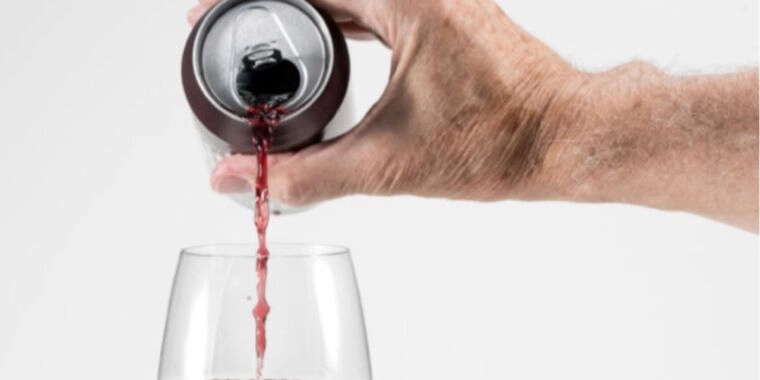
– Apr 23, 2024 10:02 pm UTC
True wine aficionados might turn up their noses, but canned wines are growing in popularity, particularly among younger crowds during the summer months, when style often takes a back seat to convenience. Yet these same wines can go bad rather quickly, taking on distinctly displeasing notes of rotten eggs or dirty socks. Scientists at Cornell University conducted a study of all the relevant compounds and came up with a few helpful tips for frustrated winemakers to keep canned wines from spoiling. The researchers outlined their findings in a recent paper published in the American Journal of Enology and Viticulture.
“The current generation of wine consumers coming of age now, they want a beverage that’s portable and they can bring with them to drink at a concert or take to the pool,” said Gavin Sacks, a food chemist at Cornell. “That doesn’t really describe a cork-finished, glass-packaged wine. However, it describes a can very nicely.”
According to a 2004 article in Wine & Vines magazine, canned beer first appeared in the US in 1935, and three US wineries tried to follow suit for the next three years. Those efforts failed because it proved to be unusually challenging to produce a stable canned wine. One batch was tainted by “Fresno mold“; another batch resulted in cloudy wine within just two months; and the third batch of wine had a disastrous combination of low pH and high oxygen content, causing the wine to eat tiny holes in the cans. Nonetheless, wineries sporadically kept trying to can their product over the ensuing decades, with failed attempts in the 1950s and 1970s. United and Delta Airlines briefly had a short-lived partnership with wineries for canned wine in the early 1980s, but passengers balked at the notion.
The biggest issue was the plastic coating used to line the aluminum cans. You needed the lining because the wine would otherwise chemically react with the aluminum. But the plastic liners degraded quickly, and the wine would soon reek of dirty socks or rotten eggs, thanks to high concentrations of hydrogen sulfide. The canned wines also didn’t have much longevity, with a shelf life of just six months.
Thanks to vastly improved packing processes in the early 2000s, canned wine seems to finally be finding its niche in the market, initially driven by demand in Japan and other Asian markets and expanding after 2014 to Australia, New Zealand, the US, and the UK. In the US alone, projected sales of canned wines are expected to grow from $643 million in 2024 to $3.12 billion in 2034—a compound annual growth rate of 10.5 percent.
Granted, we won’t be seeing a fine Bordeaux in a can anytime soon; most canned wine comes in the form of spritzers, wine coolers, and cheaper rosés, whites, or sparkling wines. The largest US producers are EJ Gallo, which sells Barefoot Refresh Spritzers, and Francis Ford Coppola Winery, which markets the Sofia Mini, Underwood, and Babe brands.
There are plenty of oft-cited advantages to putting wine in cans. It’s super practical for picnics, camping, summer BBQs, or days at the beach, for example, and for the weight-conscious, it helps with portion control, since you don’t have to open an entire bottle. Canned wines are also touted as having a lower carbon footprint compared to glass—although that is a tricky calculation—and the aluminum is 100 percent recyclable.
This latest research originated from a conference session spearheaded by Sacks. The goal was to assist local vineyards in enhancing their understanding of prime ways to maintain the taste, aroma, and longevity of canned wines. Canned wines are still struggling with challenges such as corrosion, seepage, and undesirable flavours, like the notorious rotten egg odor. “They stated, ‘We’re adhering to all the guidelines from the tin manufacturers and we’re still grappling with these issues, can you offer us some guidance?'” expressed Sacks. “The primary emphasis was on identifying the compounds causing the problem, what was leading to corrosion and off smells, and why were these issues prevalent in wines but not in fizzy drinks? Why doesn’t Coca-Cola face this problem?”
Navigating the Challenging Landscape of Craft Beer: Insight from the Brewers Association

Bart Watson, chief economist with the Brewers Association, delivers the annual state of the industry address at the Craft Brewers Conference.
The Brewers Association, the trade association representing America’s small and independent breweries, delivered its annual state of the industry address today. Bart Watson, chief economist with the Brewers Association, described it as a “challenging landscape.”
“There were some positives and some negatives,” said Watson during his address to thousands of brewers and industry professionals attending the annual Craft Brewers Conference, this year being held in Las Vegas, Nevada.
Craft beer production was down 1%. Categories within the industry saw various levels of growth and shrinkage. Taprooms were down 2%, brewpubs were down 4%, contract and alternating proprietorship beer companies were flat, regional breweries grew by 1%, while microbreweries were down 5%. Watson noted that there were breweries within all of those categories that have different levels of success. “44% of breweries found growth last year,” said Watson in his presentation.
The sector’s number of consumers is now quite stable in terms of its growth, says Watson, indicating that the rise of individuals drinking more craft beer now matches the decline. However, Watson continues that consumers remain willing to pay for beers they highly appreciate, with close to $30 billion spent on small and independent brewing last year.
Watson also points out that alongside the lack of growth, numerous breweries struggle with their finances due to the increasing cost of goods at a rate that surpasses the increase in prices. Successful breweries often focus on operations, sometimes through collaboration and partnerships to achieve economies of scale, whilst others succeed through finding innovative methods to distribute their craft beers and associating the drink with various occasions.
Watson provides an estimate that shows “125 million Americans who drink didn’t have a craft beer last month,” implying that there are still untapped avenues for breweries to explore for growth. Addressing brewers directly, he states that “Many of your customers are fiercely loyal. Breweries that are succeeding are finding ways to have customers drink their products on more occasions”.
“Craft beer as a category has seen fads in beverage alcohol come and go,” said Watson. “But craft is here to stay.”
British ‘Travel Addict’ Arrested in Qatar Over Souvenir Rum Bottle

Travel blogger Laura Kemp has safely travelled to 58 countries including warzones, but she had a harrowing experience in Qatar that nearly landed her in prison when customs officials discovered alcohol in her luggage.
This British travel enthusiast, who has visited 35 countries in the last two years, spending a whopping amount on her adventures, cautions others about a grave mistake she made in Qatar. It was an error that almost cost her her freedom.
Laura Kemp spends around £30k yearly on her travel passions, with recent trips to exotic destinations like Bora Bora and Fiji. However, during one not-so-pleasant incident, she was detained in Qatar when a bottle of rum was seized from her.
Born in Cheltenham, Gloucestershire, Laura made the inadvertent error of not recalling the stringent alcohol restrictions of Qatar during her recent visit. Violation of these rules can result in a punishment of up to six months in jail and a £600 fine for residents of this Middle Eastern nation. Expats also face the threat of removal.
She spoke out to warn other travellers after the bottle of coconut Takamaka rum she’d bought in the Seychelles as a souvenir was spotted as she went through customs. “Immediately, multiple staff took me away for questioning, a process that felt both surreal and intimidating,” she said.
“Although the staff were respectful, I was completely in the dark as to what was happening, and my boyfriend had to wait for me for hours while I was going through the ordeal. I remember feeling so nervous about what was going to happen – would I be deported? Would I get a criminal record?
“The officers explained the seriousness of alcohol-related offences in Qatar, emphasising that I could have faced much harsher consequences, including a longer period of imprisonment or even deportation, had they not considered the circumstances of my case and my lack of intent to break the law. In the end, they kept the rum, and I was permitted to leave, but this experience was a stark reminder of the importance of understanding and respecting local customs and regulations, especially concerning alcohol. I’ll never make the same mistake again”.
In 2011, Irish citizen Conor Hayes was sentenced to one month in prison in the country after being convicted of drinking without a licence and public obscenity. He spoke out ahead of the 2022 Qatar World Cup warning Brits of its strict drinking and marital sex culture.
In addition to visiting exotic, far-off locations, Laura has journeyed to numerous destinations that are generally discouraged by the Foreign Office. These include locations such as Palestine, Kosovo, and North Korea. “I’ve been obsessed with seeing as much of the world as possible and I am constantly planning my next trip if I’m not already overseas,” explained Laura, who first caught the travel bug in 2012 while residing in Vancouver.
“I never had the chance to travel when I was younger, so I was always fascinated by stories of childhood friends who had traveled abroad.” Laura has since visited 58 countries, including South Korea, Japan, Fiji, North Macedonia, Serbia, Azerbaijan, Armenia, Georgia, Canada and the USA.
She shares about her adventures on TikTok, where she has confessed to receiving criticism from some who label her as “spoilt” for spending such vast amounts on travel – she estimates it costs her around £30,000 per year. “I’ve always self-funded my travel and worked incredibly hard along the journey, so these comments make me laugh,” she remarked.
Fancy an escape? You are invited to subscribe to the Chill newsletter for weekly inspiration and advice on UK holidays.
Flight Chaos: Celtic Fan Attacks Police Officers After Consuming a Bottle of Vodka

To view this video please enable JavaScript, and consider upgrading to a web browser that
video
A drunk Celtic fan punched police officers and passengers on an easyJet flight after ‘downing a bottle of vodka’.
Video footage taken onboard the plane shows a man wearing a Celtic football top angrily lunging at others on the flight from Edinburgh to Antalya, Turkey on Saturday.
It’s thought a fight broke out towards the end of the flight after another Celtic supporter called the man a ‘disgrace’ because of his drunken behaviour, reports the MailOnline.
One of the passengers narrated that the man was consuming a bottle of Gold Ivy vodka which the crew ultimately seized.
The provided footage depicted him on a standing position, leaning forwards the seat ahead of him attempting to assault a passenger. Later, he advanced to the aisle aimed at assaulting another individual who seemed to be a Turkish cop.
Despite the numerous people, inclusive of the staff, attempting to harness him, the screams of at least one individual can be discernible.
The spectacle was observed by other passengers, amongst whom children were present, several were seen capturing the commotion.
Some parents attempt to comfort their children by telling them ‘it’s alright, it’s OK’.
A passenger recounted: ‘Before the man assaulted the officer, he had been consuming alcohol and had finished a bottle of vodka he had smuggled onto the plane. He also tried engaging with girls towards the rear of the plane near the restrooms, while in a heavily intoxicated state.’
The passenger further disclosed that an air hostess attempted to confiscate the vodka bottle from the man. However, he insisted that he needed it for ‘self-defense’.
‘Towards the conclusion of the flight, he was being very unruly, incessantly shouting and repeatedly fetching his bag from the luggage compartment. The airline staff repeatedly told him to sit down. Another Celtic supporter called out his disgraceful behavior.’
He then tried to fight the other fan, the passenger explained, while his partner attempted to hold him down.
‘Then police came onboard [after landing] and he tried to throw punches at them,’ he added.
The man was taken off the plane by police and security staff, at which point several passengers cheered, added the holidaymaker.
The passenger said his 12-year-old son was ‘stressed’ during the fight and several other children could be heard crying.
As there were a number of empty seats towards the back of the plane, some families moved to get away from the Celtic fan.
An easyJet spokesperson told Metro.co.uk: ‘easyJet can confirm that police attended a flight to Antalya on April 20 on arrival due to a passenger behaving disruptively on board.
‘easyJet’s crew are trained to assess and evaluate all situations and to act quickly and appropriately to ensure that the safety of passengers is not compromised at any time.
‘Dine-and-dash’ family who didn’t pay £329 bill targeted seven restaurants in past year
Man glassed in the face after telling woman she looked like she was 43.
The exact date the UK will face 10 days of rain
Teacher’s cunning plan to tackle phone addiction (but the kids won’t like it)
‘Whilst such incidents are rare we take them very seriously and do not tolerate abusive or threatening behaviour.
‘The safety and wellbeing of all our customers and crew is always our highest priority.’
In September last year Spanish police stormed an easyJet flight travelling from Manchester to the Canary Islands due to ‘eight violent passengers’ on board.
Get in touch with our news team by emailing us at webnews@metro.co.uk.
For more stories like this, check our news page.
MORE : These gnomes live on a rock in Scotland and no one knows why
MORE : British tourist, 21, named after plunging to death from hotel balcony in Turkey
MORE : Drivers are getting their knickers in a twist over the width of this new cycle path
Affordable Kosher Wines Ideal for Passover and Beyond: A Wine Press Review

Passover starts (or started, depending on when you’re reading this article) at sundown on Monday, April 22.
The annual Jewish holiday commemorating their liberation from slavery continues until the evening of April 30.
During this annual holiday, there are many special, traditional feasts, including Seder on April 22 and April 23.
As part of the Seder, many people drink wine. And for many Jewish people, that means drinking only kosher wine.
There are many rules about what makes a wine kosher. There’s also a fair bit of confusion.
This week, you can learn all about kosher wines, as well as tasting notes for a few suggested kosher wines, many of which cost less than $16 a bottle.
Hope you enjoy.
WHAT IS KOSHER WINE?
First, let’s talk a bit about some of the misconceptions about kosher wine. Contrary to popular belief, making kosher wine does not involve a rabbi. The wine simply needs to be made by people who observe the Jewish Sabbath, the traditional day of rest on Saturday.
Other rules apply to kosher wine, including making sure that all the ingredients in the wine are kosher. This means no animal products added to the wine. Kosher wines should also not come into contact with bread or grain products.
Additional rules apply. Fortunately, you don’t have worry about memorizing these rules. Many wine stores have sections set aside where you can easily find kosher wines. And many winemakers produce wines that have been certified kosher and say so on the label.
WHO PRODUCES KOSHER WINE?
Another myth about kosher wine is that it only comes from certain producers from parts of the world. The truth is winemakers anywhere in the world can make kosher wine. And many winemakers do just that. As a result, there are kosher wines from Israel, Australia, Argentina, California and France, including certain wineries in Bordeaux and Champagne.
TASTING NOTES
2021 Barkan Vineyards Classic Chardonnay ($15.99 at Table & Vine in West Springfield)
Country – Israel
Grape – Chardonnay
Tasting Notes – If you love bone-dry white wines, you will absolutely love this outstanding, understated wine. This subtle white wine has a fascinating blend of soft, understated flavors ranging from peach to sea salt, roasted butter and a slight hint of green apple. Highly recommend.
2021 Barkan Vineyards Classic Pinot Noir Negev Israel ($13.99 at Table & Vine)
Country – Israel
Grape – Pinot Noir
Tasting Notes – Soft, subtle, fruit-forward red wine that really hits its stride the day after you open the wine. The first day, I found the wine a bit too fruity (almost raspberry like) for my taste. The second day, the wine really smooths out and the fruit flavors are less intense and more subtle and cherry like.
2021 Teal Lake Cabernet Merlot ($12.99 Suggested Retail Price)
Country – Australia
Grape – Blend of cabernet sauvignon and merlot
Tasting Notes – This light, refreshing, flinty dry red wine from Australia absolutely blew me away. Flavorful and extremely dry, this wine tastes great straight out of the bottle and the next day as well. With flavors ranging from toasted almonds to dried raspberries, my wife and I adored this wine right from the start. Let me add that the flavors linger long after each sip.
2022 Domaine Bousquet Alavida Malbec ($16.99 at Table & Vine)
Country – Argentina
Grape – 100% malbec
Tasting Notes – For those of you who prefer slightly bigger, earthier wines, this robust yet smooth malbec from Argentina just might be the red wine for you. Bold fruit flavors include hints of plum, cherry and blackberry. There are also slight hints of nuts, particular almonds, on the finish that give this wine a distinct, delightful taste.
2019 Domaines Barons de Rothschild Legende Bordeaux Rouge ($17.99 at Table & Vine)
Country – Bordeaux, France
Grape – 50% cabernet sauvignon, 50% merlot
Tasting Notes – This delightful blended red wine illustrates why France’s Bordeaux region has such as well-earned reputation for making elegant, charming wines. Made with a classic Bordeaux blend of cabernet sauvignon and merlot grapes, the flavors here are soft and subtle with hints of fresh fruit (blackberry and cherry) without being overpowering.
Laurent-Perrier La Cuvee Brut Champagne ($64.99 at Table & Vine)
Country – Champagne, France
Grape – 50% chardonnay, 35% pinot noir, 15%, pinot meunier
Tasting Notes – A classic bone-dry Champagne from one the oldest Champagne houses (founded in 1812) in France’s Champagne region, this delicious sparkling wine hits all the right notes. Its flavors are crisp, dry, slightly nutty (think roasted almonds) and refreshing.
Cheers!
Wine Press by Ken Ross appears on Masslive.com every Monday and in The Republican’s Weekend section every Thursday.
If you purchase a product or register for an account through a link on our site, we may receive compensation. By using this site, you consent to our User Agreement and agree that your clicks, interactions, and personal information may be collected, recorded, and/or stored by us and social media and other third-party partners in accordance with our Privacy Policy.