Unveiling the Mystery: Why Does Canned Wine Sometimes Smell Like Rotten Eggs While Beer and Coke Don’t?
– Apr 23, 2024 10:02 pm UTC
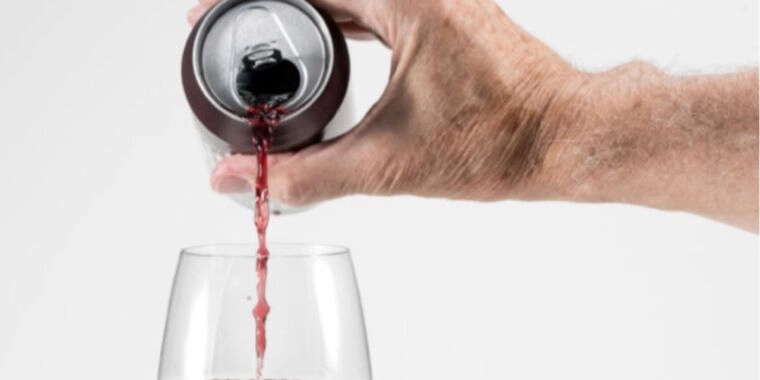
True wine aficionados might turn up their noses, but canned wines are growing in popularity, particularly among younger crowds during the summer months, when style often takes a back seat to convenience. Yet these same wines can go bad rather quickly, taking on distinctly displeasing notes of rotten eggs or dirty socks. Scientists at Cornell University conducted a study of all the relevant compounds and came up with a few helpful tips for frustrated winemakers to keep canned wines from spoiling. The researchers outlined their findings in a recent paper published in the American Journal of Enology and Viticulture.
“The current generation of wine consumers coming of age now, they want a beverage that’s portable and they can bring with them to drink at a concert or take to the pool,” said Gavin Sacks, a food chemist at Cornell. “That doesn’t really describe a cork-finished, glass-packaged wine. However, it describes a can very nicely.”
According to a 2004 article in Wine & Vines magazine, canned beer first appeared in the US in 1935, and three US wineries tried to follow suit for the next three years. Those efforts failed because it proved to be unusually challenging to produce a stable canned wine. One batch was tainted by “Fresno mold“; another batch resulted in cloudy wine within just two months; and the third batch of wine had a disastrous combination of low pH and high oxygen content, causing the wine to eat tiny holes in the cans. Nonetheless, wineries sporadically kept trying to can their product over the ensuing decades, with failed attempts in the 1950s and 1970s. United and Delta Airlines briefly had a short-lived partnership with wineries for canned wine in the early 1980s, but passengers balked at the notion.
The biggest issue was the plastic coating used to line the aluminum cans. You needed the lining because the wine would otherwise chemically react with the aluminum. But the plastic liners degraded quickly, and the wine would soon reek of dirty socks or rotten eggs, thanks to high concentrations of hydrogen sulfide. The canned wines also didn’t have much longevity, with a shelf life of just six months.
Thanks to vastly improved packing processes in the early 2000s, canned wine seems to finally be finding its niche in the market, initially driven by demand in Japan and other Asian markets and expanding after 2014 to Australia, New Zealand, the US, and the UK. In the US alone, projected sales of canned wines are expected to grow from $643 million in 2024 to $3.12 billion in 2034—a compound annual growth rate of 10.5 percent.
Granted, we won’t be seeing a fine Bordeaux in a can anytime soon; most canned wine comes in the form of spritzers, wine coolers, and cheaper rosés, whites, or sparkling wines. The largest US producers are EJ Gallo, which sells Barefoot Refresh Spritzers, and Francis Ford Coppola Winery, which markets the Sofia Mini, Underwood, and Babe brands.
There are plenty of oft-cited advantages to putting wine in cans. It’s super practical for picnics, camping, summer BBQs, or days at the beach, for example, and for the weight-conscious, it helps with portion control, since you don’t have to open an entire bottle. Canned wines are also touted as having a lower carbon footprint compared to glass—although that is a tricky calculation—and the aluminum is 100 percent recyclable.
This latest research originated from a conference session spearheaded by Sacks. The goal was to assist local vineyards in enhancing their understanding of prime ways to maintain the taste, aroma, and longevity of canned wines. Canned wines are still struggling with challenges such as corrosion, seepage, and undesirable flavours, like the notorious rotten egg odor. “They stated, ‘We’re adhering to all the guidelines from the tin manufacturers and we’re still grappling with these issues, can you offer us some guidance?'” expressed Sacks. “The primary emphasis was on identifying the compounds causing the problem, what was leading to corrosion and off smells, and why were these issues prevalent in wines but not in fizzy drinks? Why doesn’t Coca-Cola face this problem?”
Navigating the Challenging Landscape of Craft Beer: Insight from the Brewers Association

Bart Watson, chief economist with the Brewers Association, delivers the annual state of the industry address at the Craft Brewers Conference.
The Brewers Association, the trade association representing America’s small and independent breweries, delivered its annual state of the industry address today. Bart Watson, chief economist with the Brewers Association, described it as a “challenging landscape.”
“There were some positives and some negatives,” said Watson during his address to thousands of brewers and industry professionals attending the annual Craft Brewers Conference, this year being held in Las Vegas, Nevada.
Craft beer production was down 1%. Categories within the industry saw various levels of growth and shrinkage. Taprooms were down 2%, brewpubs were down 4%, contract and alternating proprietorship beer companies were flat, regional breweries grew by 1%, while microbreweries were down 5%. Watson noted that there were breweries within all of those categories that have different levels of success. “44% of breweries found growth last year,” said Watson in his presentation.
The sector’s number of consumers is now quite stable in terms of its growth, says Watson, indicating that the rise of individuals drinking more craft beer now matches the decline. However, Watson continues that consumers remain willing to pay for beers they highly appreciate, with close to $30 billion spent on small and independent brewing last year.
Watson also points out that alongside the lack of growth, numerous breweries struggle with their finances due to the increasing cost of goods at a rate that surpasses the increase in prices. Successful breweries often focus on operations, sometimes through collaboration and partnerships to achieve economies of scale, whilst others succeed through finding innovative methods to distribute their craft beers and associating the drink with various occasions.
Watson provides an estimate that shows “125 million Americans who drink didn’t have a craft beer last month,” implying that there are still untapped avenues for breweries to explore for growth. Addressing brewers directly, he states that “Many of your customers are fiercely loyal. Breweries that are succeeding are finding ways to have customers drink their products on more occasions”.
“Craft beer as a category has seen fads in beverage alcohol come and go,” said Watson. “But craft is here to stay.”
British ‘Travel Addict’ Arrested in Qatar Over Souvenir Rum Bottle

Travel blogger Laura Kemp has safely travelled to 58 countries including warzones, but she had a harrowing experience in Qatar that nearly landed her in prison when customs officials discovered alcohol in her luggage.
This British travel enthusiast, who has visited 35 countries in the last two years, spending a whopping amount on her adventures, cautions others about a grave mistake she made in Qatar. It was an error that almost cost her her freedom.
Laura Kemp spends around £30k yearly on her travel passions, with recent trips to exotic destinations like Bora Bora and Fiji. However, during one not-so-pleasant incident, she was detained in Qatar when a bottle of rum was seized from her.
Born in Cheltenham, Gloucestershire, Laura made the inadvertent error of not recalling the stringent alcohol restrictions of Qatar during her recent visit. Violation of these rules can result in a punishment of up to six months in jail and a £600 fine for residents of this Middle Eastern nation. Expats also face the threat of removal.
She spoke out to warn other travellers after the bottle of coconut Takamaka rum she’d bought in the Seychelles as a souvenir was spotted as she went through customs. “Immediately, multiple staff took me away for questioning, a process that felt both surreal and intimidating,” she said.
“Although the staff were respectful, I was completely in the dark as to what was happening, and my boyfriend had to wait for me for hours while I was going through the ordeal. I remember feeling so nervous about what was going to happen – would I be deported? Would I get a criminal record?
“The officers explained the seriousness of alcohol-related offences in Qatar, emphasising that I could have faced much harsher consequences, including a longer period of imprisonment or even deportation, had they not considered the circumstances of my case and my lack of intent to break the law. In the end, they kept the rum, and I was permitted to leave, but this experience was a stark reminder of the importance of understanding and respecting local customs and regulations, especially concerning alcohol. I’ll never make the same mistake again”.
In 2011, Irish citizen Conor Hayes was sentenced to one month in prison in the country after being convicted of drinking without a licence and public obscenity. He spoke out ahead of the 2022 Qatar World Cup warning Brits of its strict drinking and marital sex culture.
In addition to visiting exotic, far-off locations, Laura has journeyed to numerous destinations that are generally discouraged by the Foreign Office. These include locations such as Palestine, Kosovo, and North Korea. “I’ve been obsessed with seeing as much of the world as possible and I am constantly planning my next trip if I’m not already overseas,” explained Laura, who first caught the travel bug in 2012 while residing in Vancouver.
“I never had the chance to travel when I was younger, so I was always fascinated by stories of childhood friends who had traveled abroad.” Laura has since visited 58 countries, including South Korea, Japan, Fiji, North Macedonia, Serbia, Azerbaijan, Armenia, Georgia, Canada and the USA.
She shares about her adventures on TikTok, where she has confessed to receiving criticism from some who label her as “spoilt” for spending such vast amounts on travel – she estimates it costs her around £30,000 per year. “I’ve always self-funded my travel and worked incredibly hard along the journey, so these comments make me laugh,” she remarked.
Fancy an escape? You are invited to subscribe to the Chill newsletter for weekly inspiration and advice on UK holidays.
Flight Chaos: Celtic Fan Attacks Police Officers After Consuming a Bottle of Vodka

To view this video please enable JavaScript, and consider upgrading to a web browser that
video
A drunk Celtic fan punched police officers and passengers on an easyJet flight after ‘downing a bottle of vodka’.
Video footage taken onboard the plane shows a man wearing a Celtic football top angrily lunging at others on the flight from Edinburgh to Antalya, Turkey on Saturday.
It’s thought a fight broke out towards the end of the flight after another Celtic supporter called the man a ‘disgrace’ because of his drunken behaviour, reports the MailOnline.
One of the passengers narrated that the man was consuming a bottle of Gold Ivy vodka which the crew ultimately seized.
The provided footage depicted him on a standing position, leaning forwards the seat ahead of him attempting to assault a passenger. Later, he advanced to the aisle aimed at assaulting another individual who seemed to be a Turkish cop.
Despite the numerous people, inclusive of the staff, attempting to harness him, the screams of at least one individual can be discernible.
The spectacle was observed by other passengers, amongst whom children were present, several were seen capturing the commotion.
Some parents attempt to comfort their children by telling them ‘it’s alright, it’s OK’.
A passenger recounted: ‘Before the man assaulted the officer, he had been consuming alcohol and had finished a bottle of vodka he had smuggled onto the plane. He also tried engaging with girls towards the rear of the plane near the restrooms, while in a heavily intoxicated state.’
The passenger further disclosed that an air hostess attempted to confiscate the vodka bottle from the man. However, he insisted that he needed it for ‘self-defense’.
‘Towards the conclusion of the flight, he was being very unruly, incessantly shouting and repeatedly fetching his bag from the luggage compartment. The airline staff repeatedly told him to sit down. Another Celtic supporter called out his disgraceful behavior.’
He then tried to fight the other fan, the passenger explained, while his partner attempted to hold him down.
‘Then police came onboard [after landing] and he tried to throw punches at them,’ he added.
The man was taken off the plane by police and security staff, at which point several passengers cheered, added the holidaymaker.
The passenger said his 12-year-old son was ‘stressed’ during the fight and several other children could be heard crying.
As there were a number of empty seats towards the back of the plane, some families moved to get away from the Celtic fan.
An easyJet spokesperson told Metro.co.uk: ‘easyJet can confirm that police attended a flight to Antalya on April 20 on arrival due to a passenger behaving disruptively on board.
‘easyJet’s crew are trained to assess and evaluate all situations and to act quickly and appropriately to ensure that the safety of passengers is not compromised at any time.
‘Dine-and-dash’ family who didn’t pay £329 bill targeted seven restaurants in past year
Man glassed in the face after telling woman she looked like she was 43.
The exact date the UK will face 10 days of rain
Teacher’s cunning plan to tackle phone addiction (but the kids won’t like it)
‘Whilst such incidents are rare we take them very seriously and do not tolerate abusive or threatening behaviour.
‘The safety and wellbeing of all our customers and crew is always our highest priority.’
In September last year Spanish police stormed an easyJet flight travelling from Manchester to the Canary Islands due to ‘eight violent passengers’ on board.
Get in touch with our news team by emailing us at webnews@metro.co.uk.
For more stories like this, check our news page.
MORE : These gnomes live on a rock in Scotland and no one knows why
MORE : British tourist, 21, named after plunging to death from hotel balcony in Turkey
MORE : Drivers are getting their knickers in a twist over the width of this new cycle path
Affordable Kosher Wines Ideal for Passover and Beyond: A Wine Press Review

Passover starts (or started, depending on when you’re reading this article) at sundown on Monday, April 22.
The annual Jewish holiday commemorating their liberation from slavery continues until the evening of April 30.
During this annual holiday, there are many special, traditional feasts, including Seder on April 22 and April 23.
As part of the Seder, many people drink wine. And for many Jewish people, that means drinking only kosher wine.
There are many rules about what makes a wine kosher. There’s also a fair bit of confusion.
This week, you can learn all about kosher wines, as well as tasting notes for a few suggested kosher wines, many of which cost less than $16 a bottle.
Hope you enjoy.
WHAT IS KOSHER WINE?
First, let’s talk a bit about some of the misconceptions about kosher wine. Contrary to popular belief, making kosher wine does not involve a rabbi. The wine simply needs to be made by people who observe the Jewish Sabbath, the traditional day of rest on Saturday.
Other rules apply to kosher wine, including making sure that all the ingredients in the wine are kosher. This means no animal products added to the wine. Kosher wines should also not come into contact with bread or grain products.
Additional rules apply. Fortunately, you don’t have worry about memorizing these rules. Many wine stores have sections set aside where you can easily find kosher wines. And many winemakers produce wines that have been certified kosher and say so on the label.
WHO PRODUCES KOSHER WINE?
Another myth about kosher wine is that it only comes from certain producers from parts of the world. The truth is winemakers anywhere in the world can make kosher wine. And many winemakers do just that. As a result, there are kosher wines from Israel, Australia, Argentina, California and France, including certain wineries in Bordeaux and Champagne.
TASTING NOTES
2021 Barkan Vineyards Classic Chardonnay ($15.99 at Table & Vine in West Springfield)
Country – Israel
Grape – Chardonnay
Tasting Notes – If you love bone-dry white wines, you will absolutely love this outstanding, understated wine. This subtle white wine has a fascinating blend of soft, understated flavors ranging from peach to sea salt, roasted butter and a slight hint of green apple. Highly recommend.
2021 Barkan Vineyards Classic Pinot Noir Negev Israel ($13.99 at Table & Vine)
Country – Israel
Grape – Pinot Noir
Tasting Notes – Soft, subtle, fruit-forward red wine that really hits its stride the day after you open the wine. The first day, I found the wine a bit too fruity (almost raspberry like) for my taste. The second day, the wine really smooths out and the fruit flavors are less intense and more subtle and cherry like.
2021 Teal Lake Cabernet Merlot ($12.99 Suggested Retail Price)
Country – Australia
Grape – Blend of cabernet sauvignon and merlot
Tasting Notes – This light, refreshing, flinty dry red wine from Australia absolutely blew me away. Flavorful and extremely dry, this wine tastes great straight out of the bottle and the next day as well. With flavors ranging from toasted almonds to dried raspberries, my wife and I adored this wine right from the start. Let me add that the flavors linger long after each sip.
2022 Domaine Bousquet Alavida Malbec ($16.99 at Table & Vine)
Country – Argentina
Grape – 100% malbec
Tasting Notes – For those of you who prefer slightly bigger, earthier wines, this robust yet smooth malbec from Argentina just might be the red wine for you. Bold fruit flavors include hints of plum, cherry and blackberry. There are also slight hints of nuts, particular almonds, on the finish that give this wine a distinct, delightful taste.
2019 Domaines Barons de Rothschild Legende Bordeaux Rouge ($17.99 at Table & Vine)
Country – Bordeaux, France
Grape – 50% cabernet sauvignon, 50% merlot
Tasting Notes – This delightful blended red wine illustrates why France’s Bordeaux region has such as well-earned reputation for making elegant, charming wines. Made with a classic Bordeaux blend of cabernet sauvignon and merlot grapes, the flavors here are soft and subtle with hints of fresh fruit (blackberry and cherry) without being overpowering.
Laurent-Perrier La Cuvee Brut Champagne ($64.99 at Table & Vine)
Country – Champagne, France
Grape – 50% chardonnay, 35% pinot noir, 15%, pinot meunier
Tasting Notes – A classic bone-dry Champagne from one the oldest Champagne houses (founded in 1812) in France’s Champagne region, this delicious sparkling wine hits all the right notes. Its flavors are crisp, dry, slightly nutty (think roasted almonds) and refreshing.
Cheers!
Wine Press by Ken Ross appears on Masslive.com every Monday and in The Republican’s Weekend section every Thursday.
If you purchase a product or register for an account through a link on our site, we may receive compensation. By using this site, you consent to our User Agreement and agree that your clicks, interactions, and personal information may be collected, recorded, and/or stored by us and social media and other third-party partners in accordance with our Privacy Policy.
Exploring the Rich History of Whiskey in America

by: Larry Potash
Posted: Apr 22, 2024 / 04:37 AM CDT
Updated: Apr 22, 2024 / 07:13 AM CDT
Whiskey has long been at the center of controversy, corruption, and conversation in America. Dark Spirits have made a comeback of late, with distilleries growing at a pace of 15% a year in the United States, in no small part because of its backstory.
In this piece for Backstory, Larry Potash digs deep into the history of whiskey, including Chicago’s starring role.
Backstory with Larry Potash airs Sunday nights at 6:30 p.m. and 11 p.m. on WGN, or stream it anytime on the WGN+ app on your smart TV with Amazon Fire, Roku, and Apple TV.
Check out the Backstory podcast at WGNtv.com/Backstory via Apple Podcasts, Google Play, or wherever you get your podcasts.
Δ
Copyright 2024 Nexstar Media Inc. All rights reserved. This material may not be published, broadcast, rewritten, or redistributed.
An air purifier can make or break home or office life for someone who suffers from allergies.
Want to know how you can best celebrate Earth Day? Incorporate some of these eco-friendly yard care products into your life.
Amazon now presents a Mother’s Day shop featuring a handpicked gift list filled with fantastic suggestions if you’re still undecided.
Beer Nut: The Resilience of New England in the Craft Beer Market

When it comes to craft beer, New England actually compares favorably to California in certain ways.
This might be surprising to some, as California is a renowned craft beer mecca, and more than twice the size (both in population and land mass) of all six New England states combined.
The way I’m writing about today is pretty specific but still notable: In a recent report from the Brewers Association, California had 11 of the top 50 producing craft beer companies, and New England had eight. I’d say that’s an impressive number for New England, given the size disparity between the two regions. Of course, Oregon, which is much, much smaller than both California and New England, had six of the top 50, so that’s even more formidable.
These statistics came from the Brewers Association’s recent annual report on production figures for the American craft brewing industry.
Of the top 50, Massachusetts certainly held its own with three entries: Boston Beer Co. (No. 2), Boston’s Harpoon (No. 18) and Jack’s Abby in Framingham (No. 38). While Connecticut only had one, it was a surprising one to me: Athletic Brewing Co. in Milford, a brewer of nonalcoholic beers, which came in at No. 10. This goes to show how well a good NA beer can do. (I’ll be writing about a few more NA brews in the coming weeks.)
Maine’s Allagash (15) and Shipyard (46) both charted, as did Vermont’s Fiddlehead (28) and Rhode Island’s Narragansett (23). New Hampshire was shut out.
The number of operating craft breweries also kept climbing in 2023, reaching an all-time high of 9,761. New brewery openings (495) declined from the previous year, and closings (418) went up, but that still yielded an overall gain for the year. Also, craft brewers directly employed 191,421 people in 2023, which meant a 1.1% increase over 2022.
Bart Watson, vice president of strategy and chief economist of the Brewers Association, said that 2023 was a “competitive and challenging year for small and independent brewers.”
“Nevertheless, even as growth has downshifted, small brewers have proved quite resilient, as seen in the increase in number of breweries, relatively low closing rates, and gains in onsite sales and jobs,” he said.
And while the overall beer market saw a downturn of 5.1% in terms of volume in 2023, craft beer actually gained market share, as the craft beer volume decline was only 1%. Craft beer now holds a 13.3% market share of the overall U.S. beer world.
“While distribution is as competitive as ever, we continue to see success stories and pockets of growth across the top 50 list,” Watson said. “Even in an era of slow growth, the strongest brands still resonate with beer drinkers, regardless of company size or location.”
If you purchase a product or register for an account through a link on our site, we may receive compensation. By using this site, you consent to our User Agreement and agree that your clicks, interactions, and personal information may be collected, recorded, and/or stored by us and social media and other third-party partners in accordance with our Privacy Policy.
Unearthing the Roots of a Whiskey Empire

by: Larry Potash
Posted: Apr 22, 2024 / 04:02 AM CDT
Updated: Apr 19, 2024 / 11:58 AM CDT
Farmer Dan McCall had a whiskey still on his property in 1850s Tennessee. The problem? He was also a Lutheran preacher. One of his farm hands, a freed slave named Nearest Green, made the whiskey and people thought it was the best.
When the farmer hired an 8-year-old boy named Jasper to help out, Green, was instructed to teach the boy. In fact, his efforts led to Jasper building an empire.
Backstory with Larry Potash airs Sunday nights at 6:30 p.m. and 11 p.m. on WGN, or stream it anytime on the WGN+ app on your smart TV with Amazon Fire, Roku, and Apple TV.
Check out the Backstory podcast at WGNtv.com/Backstory via Apple Podcasts, Google Play, or wherever you get your podcasts.
Copyright 2024 Nexstar Media Inc. All rights reserved. This material may not be published, broadcast, rewritten, or redistributed.
If you’re looking for a new dehumidifier, there are a few things you should consider before making a purchase.
Walmart is offering big savings on flash deals for outdoor toys.
Still searching for the ideal Mother’s Day present? Discover the perfect one for your mom this Mother’s Day with these outstanding choices from Amazon.
Selena-Inspired Beer Discontinued Following Cease-and-Desist Letter to Businesses

Spencer Heath, Digital Journalist
LOS ANGELES – A beer created to honor the legend of Selena Quintanilla did not last long.
According to LAist, the Los Angeles, California-area owners of a brewery called Brejeria and a Chicano lifestyle boutique teamed up to release a Selena-themed beer called “Tomo La Flor.”
The limited-edition beer was named after one of Selena’s well-known hits, “Como La Flor.” The beverage was described as a hibiscus pale ale with a hint of guava.
Before a second batch was made, the businesses were served with a cease-and-desist letter from Selena’s estate, KNUE 101.5 reported.
“We just wanted to honor Selena,” Agustin Ruelas, co-owner of Brewjeria, told NewsBytes.
This is not the first time members of Selena’s estate sued a business for using her image or likeness.
In 2023, Selena’s father, Abraham Quintanilla Jr., sued a cruise company for using the Tejano music legend’s image and likeness without the family’s permission.
Copyright 2024 by KSAT – All rights reserved.
Experience the Delights of South Bay: Upcoming Wine and Food Events

Pebble Beach Food & Wine made a fantastic return after a four-year break in the first week of April. The event was under the purview of a new management team and featured a renewed format including, for the first time, wineries like Rhys Vineyards from the Santa Cruz Mountains and Frank Family Vineyards from Napa.
If you take pleasure in a competitive wine and food pairing contest, don’t miss “The Perfect Pair” at Cabrillo College, scheduled for Saturday, April 27. The inclusive $140 ticket offers a sensory evaluation class, a walk-around tasting of Santa Cruz Mountains wines, along with an exciting food and wine pairing competition featuring creations by the Cabrillo College Culinary program students. https://winesofthesantacruzmountains.com/events/the-perfect-pair
Another notable event on April 27 is an open house at Vidovich Winery on Monte Bello Road in the Cupertino hills, from noon till 4:30 p.m. It’s a chance to meet their new winemaker, Barry Timmins, originally from New Zealand, who brings a fresh approach to the brand.
And it’s not just about Mint Juleps anymore! Kendall-Jackson has launched two limited-edition, commemorative wines for the 150th Run for the Roses on Kentucky Derby Day. The attractive labels showcase Rachel Alexandra, a retired American Thoroughbred racehorse from Stonestreet Stables, owned by the Jackson family in Lexington, KY. Rachel Alexandra has impressive victories at Churchill Downs, Belmont Park, and Saratoga Racecourse. Celebrate your Derby spirit with the 2022 “150th Running” Chardonnay (Mendocino, $14.99) and 2021 “150th Running” Cabernet (Sonoma, $24.99).
Considering a Derby-themed soiree paired with local vintages and appetizing morsels for a worthy cause? The Morgan Hill Community Foundation collaborates with the Wineries of Santa Clara Valley for the yearly Santa Clara Valley Wine Auction on May 4 at Clos LaChance Winery. The VIP room opens at 5 p.m.; general entrance is from 6-9 p.m. A live auction commences at 8 p.m. featuring fabulous prizes such as a VIP suite at a Sharks match, amazing holiday home stays and a robust meat parcel from Rocca’s market. Don your finest Kentucky Derby garb, as you’ll be in good company. Parking services provided. https://visitmorganhill.org/santaclaravalleywineauction
The Santa Cruz Mountains Wines’ “Taste Of Terroir” Dinner Series ignites with “Vineyards in the Sky,” on Friday, May 10, at Wrights Station Winery, highlighting modern Italian fare curated by Chef Nick Sherman of Trestles & Cavaletta, coupled with vintages from Big Basin Vineyards, Charmant Vineyards, Cooper-Garrod Vineyards, David Bruce Winery, Muns Vineyard, Silver Mountain Vineyards and Wrights Station. https://winesofthesantacruzmountains.com/2024-tot-dinner-series
Effervescence is essential for Mother’s Day and Mumm Napa has recently introduced new assortments of upscale domestic sparkling wines: Mumm Sparkling ($23.99) and Mumm Napa ($32.99). Both portfolios contain three cuvées, including a rosé option, and the latter features a Mumm Napa Blanc de Blancs.
For those wishing to sip lower-alcohol wines without compromising on taste, give the 2021 CRU Low Calorie Unoaked Chardonnay (Arroyo Seco), priced at $20 and 12.1 percent alcohol a try. CRU has a tasting facility in Soledad.
“Sunny With a Chance of Flowers” rosé, presented by Scheid, offers another low-alcohol option you can find easily in grocery stores. This rosé was a popular choice at the anticipated Pebble Beach Food & Wine event.
Ever thought of hosting an unforgettable party, memorial, or bridal shower in a winery? Alamitos Vineyards, located near San Jose’s Almaden Reservoir, welcomes such events. Their private chef provides delectable wine-paired gourmet offerings, from charcuterie spreads to comprehensive seven-course wine-tasting dinners. This winery can comfortably cater to private celebrations ranging from 20 to 250 guests, extending dates for both weekdays and weekends. For more details, please reach out at info@alamitosvineyards.com.