Beer-articles 1026
Whatcom Community Updates: New Outlet near Trader Joe’s, Beer Festival, and a $4 Million Hotel Renovation

Here’s your weekly roundup of the latest retail, business and restaurant activity in and around Whatcom County:
Living Pantry, an eco-friendly and natural product store, is moving its current Bellingham location and is opening next door to Trader Joe’s.
“We are looking to open as soon as possible but as with most things it is dependent upon some parts out of our control; therefore at this time, we don’t have a set date,” an email from the business stated.
Living Pantry will move from 2400 Yew St. to the new store at 2410 James St. in Bellingham. Living Pantry also has a location in Blaine at 264 H St.
The Holiday Inn Express at 4160 Meridian St. has filed a permit with the city for an interior and exterior remodel, with an estimated cost of $4 million. The permit was filed April 18 and had not been approved as of April 19.
Bellingham Beer Week, the 11-day-long beer festival and celebration, runs for a few more days. The festival is put on by 15 participating breweries and nine taprooms. It includes block parties, new beer releases, live music, brewery tours and other events.
Here’s a few events you won’t want to miss:
• Floral IPA Beer Release on Saturday, April 27 at Structures Brewing Old Town, 601 W Holly St. in Bellingham.
• April Brews Day, Bellingham’s biggest and best beer festival, runs from 5:30 p.m. to 9 p.m. Saturday, April 27 at the corner of Granary Ave & Chestnut St. in Bellingham.
• Hangover Helper Brunch, a brunch to conclude Bellingham Beer Week at 10 a.m. to Aslan Brewing’s Depot. The event will include a live DJ and brunch menu. Aslan Depot is at 1322 N. State St. in Bellingham.
Bellingham is full of local events, markets, festivals and other events during April. Here’s your guide to this month’s events, trivia nights, live music and more.
This curated weekly newsletter is a roundup of what’s new and exciting to help you live joyfully in Bellingham and Whatcom County. Click here to sign up. In your inbox every Thursday.
Uncovering Poland’s Van Gogh Masterpiece Once Sold for a Beer

Pictures by Wojtek Radwanski. Video by Damien Simonart
Poland unfurled an art exhibit on Friday in honor of its singular Van Gogh painting, a remarkable early landscape revered in millions that was once peddled by a merchant for the equivalent of a pint of beer.
The piece “Country Huts Among Trees” hails from 1883 when the penniless Dutch artist was honing his painting craft amid the bucolic surroundings of The Hague.
The diminutive oil painting, alternatively titled “Farmhouses Among Trees,” is “worth noting for its humility and for showcasing an entirely dissimilar perspective of Van Gogh,” commented Agata Smolnicka, co-custodian of the Warsaw exhibit.
He painted it with a limited palette, and not many who are familiar with his ‘Starry Night’ French phase are aware of his Dutch phase,” she declared to AFP.
“Works from The Hague are relatively rare,” Teio Meedendorp, an expert at Amsterdam’s Van Gogh Museum, which authenticated the unsigned work, conveyed.
“He created approximately 75 pieces there but only one-third survived. The majority were either lost or destroyed over the years,” he explained to AFP.
The canvas was found in a carpenter’s loft, along with a collection of Van Gogh’s other early works, after he relocated overseas.
The carpenter eventually sold “that junk” — as he called them — for a song to a hawker who peddled the pictures from his handcart.
“He brought the works to a cafe… Anyone who bought him a round of beer received a Van Gogh,” exhibition consultant Juliette van Uhm wrote in the show’s catalogue.
“Some canvases were given to children to play with; they tied them around their waists as if they were aprons,” she added.
Many were saved by a discerning tailor who tried to buy them all up. They were later exhibited and sold, with the Polish Van Gogh ending up in Switzerland.
Charles Zbigniew Carroll-Porczynski, a Polish collector stationed in Britain, made a purchase of the artwork in 1987 and subsequently gifted it to the Catholic Church in his home country.
A fresh exhibit at the Museum of John Paul II and Primate Wyszynski in Warsaw delves into distinct aspects of the masterpiece.
The painting was described as “Van Gogh in the stage prior to becoming the renowned Van Gogh” by Stefania Ambroziak, one of the co-curators. She observed that Van Gogh was at this time in the process of mastering oil paint and experimenting with color applications.
Van Gogh, by this juncture, had already invested substantial effort in perfecting his sketching skills, even though experts believed that he was not a natural talent such as Picasso or Toulouse-Lautrec.
“When you see juvenile work by Vincent, it’s a big surprise he became an artist,” Meedendorp said, laughing.
“Because he was not very good. I mean he had no natural feel for perspective and proportion.”
What he did have was speed, which is evident in the painting on show in Warsaw.
“You can distinguish the hand of a very quick painter, working wet-on-wet very quickly. And this is a wonderful example of it,” Meedendrop said.
Though the Polish painting’s palette is less vibrant than the brilliant shades often linked with Van Gogh, Meedendorp remarks that it evidences his inherent talent for colour.
“His talent in colour mixing and contrasting, particularly with the reddish and green tones, was exceptional,” said Meedendorp.
“Van Gogh was a natural colourist. However, it wasn’t until he truly studied and absorbed colours in Paris, did he evolve into the exceptional painter we know,” added Meedendorp.
The exhibition entitled “Van Gogh. The Stories of One Painting” will be on display in Warsaw until the end of December.
amj/fg
Madison Beer Brillantly Remakes ‘Jennifer’s Body’ in Her New ‘Make You Mine’ Video

Madison Beer continues to embrace contemporary classics. She released the video for her single “Make You Mine” on April 24, which showcases her in a reimagination of a noteworthy thriller scene.
The track itself sees Beer expressing a fresh obsession.
Lyrics of the chorus, “I want to feel the rush / I want to taste the crush / I want to get you going / I want to lay you down / I want to string you out / I want to make you mine,” are sung over a captivating, rhythmic beat.
In the visual representation, Beer takes on the personas of Jennifer Check and Needy Lesnicky, roles originally portrayed by Megan Fox and Amanda Seyfried in the 2009 film, Jennifer’s Body. As these characters, Beer reconstructs a number of scenes from this movie, featuring the famous hallway walk, the scene at the pool, and the dance sequence.
In a recent interview with Billboard, Beer declared “Make You Mine” as her top favorite song she’s ever crafted.
“It’s just so exhilarating, extremely feel-good song,” Beer voiced. “It’s alluring, it’s irresistible. Every single person I’ve played it for started dancing and felt an immediate boost in their mood upon listening to it, and that’s the kind of reaction I always aim for.”
The video for “Make You Mine” can be seen above.
Decoding the Best Beers for Spicy Foods: IPAs, Hazy, Kolsch or Stouts?
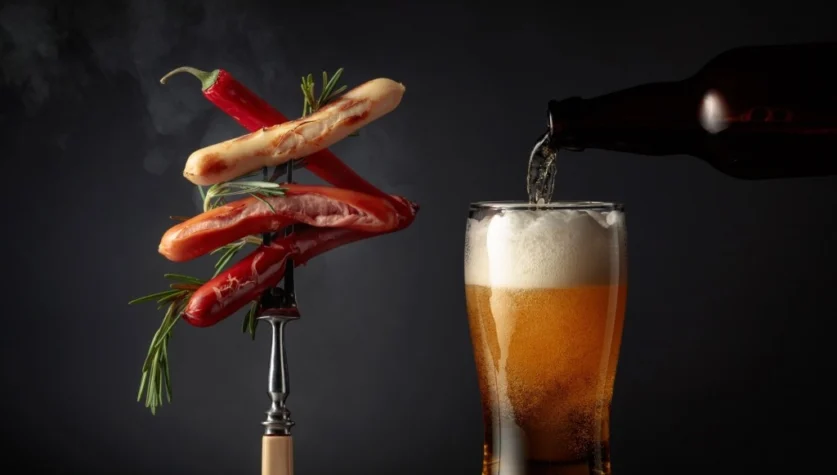
I confess, I was raised on bland meals and never nurtured a fondness for spicy food. Despite this, my spouse, kids, and companions, who enjoy spice in numerous forms, delight in provoking me to sample various dishes, usually assuring me with “It’s not excessively hot! You’ll manage.” However, I never actually do.
In my childhood, when I dared to try spiced dishes, my mother used to hand me a glass of milk to alleviate the burn I felt. I never understood why, but it seemed to do the trick. Thankfully, I found the same relief in certain beers. The right brew not only enables me to bear spicy meals but also almost savor the ordeal. And for those who already delight in the heat delivered by chili peppers, this combination is absolute perfection.
Whether you’re a spicy food veteran or a timid beginner, here are some recommendations for coupling beer with spicy meals while keeping your sanity (and hopefully without crying).
Here’s a daring suggestion: I don’t believe IPAs pair well with spicy meals. While numerous beer aficionados argue that IPAs go well with spicy dishes, they only heighten the sensation of heat. The elevated alpha acids in hops, notably prolific in IPAs, can mix with capsaicin (the active component that gives chile peppers their spiciness), forming a vicious cycle that intensifies the heat. Whether it’s the heat from habaneros or some other source, a hop-dominant beer only amplifies the spiciness.
Indeed, a cold drink provides temporary relief from the heat of spicy food. However, as your mouth warms up, the spiciness returns. This is because capsaicin, the molecule responsible for spicy heat, does not dilute in water, and beer is mostly water. Capsaicin is neutralized by fats and alcohol, explaining why milk is often recommended.
For a lasting solution, you can consider several strategies. It’s worthwhile to note that spiciness is not a flavor but a sensation, although it can combine with various flavors. Therefore, try to either pair strong with strong where suitable, or balance matching or similar tastes. Additionally, think about how sweetness or fizziness can influence the pairing.
In my experience, malt-rich and sweet beers counterbalance spiciness quite well. Therefore, I find Märzen, amber lagers, or Vienna lagers superior to IPAs. Their sweetness doesn’t conflict with the potent flavors and provides a lasting sweetness layer in your mouth.
I’d suggest pairing foods with smoky chili like chipotle or ancho with a stout, preferably one with chocolate undertones. Generally, stouts go well with hot foods. Oatmeal stouts and sweet/milk stouts are especially fitting. Oatmeal stouts derive their smoothness from the oats used in their brewing, while sweet or milk stouts are brewed with malt sugars or lactose. While not traditional milk, it neutralizes spiciness much the same. For complementing smokiness, opt for a roasted malt beer such as a brown ale.
Dark beer varieties such as black lagers, schwarzbiers, and dunkels are perfect complements to spicy dishes for several reasons, with Death and Taxes, a San Francisco-style black lager from Moonlight Brewing, being perhaps the most well-suited among them. Notably, many of such beers bear caramel undertones that further elevate their compatibility with spicy food.
Beers with high residual sugar content, including Belgian specialty ales, saisons, barley wines, and lambics, effectively neutralize the heat of capsaicins. Hazy IPAs with low bitterness also serve the same purpose.
Alternatively, some recommend countering spicy flavors with carbonated drinks. Some researchers argue that the bubbles might stimulate more pain sensors, potentially worsening the burning sensation depending on your tolerance and the spiciness of your food. However, I find bubbly drinks rather helpful in dealing with spice. If you would like to test this hypothesis, try out a Kölsch, saison, witbier, hefeweizen, biere de garde, tripel, or sparkling ale.
The art of pairing beer and food typically abides by universally accepted guidelines. However, pairing spicy food with beverages is a unique case. Some people find appeal in spicy food precisely because of the burning sensation it elicits. Thus, feel free to experiment and discover the combination that suits your preferences. If you relish the spicy thrill, opt for an IPA.
Navigating the Challenging Landscape of Craft Beer: Insight from the Brewers Association
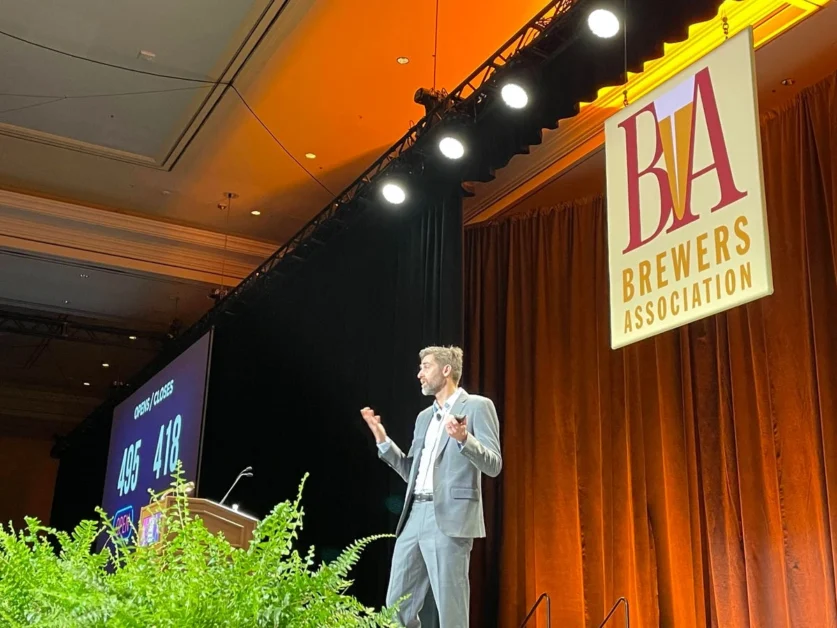
Bart Watson, chief economist with the Brewers Association, delivers the annual state of the industry address at the Craft Brewers Conference.
The Brewers Association, the trade association representing America’s small and independent breweries, delivered its annual state of the industry address today. Bart Watson, chief economist with the Brewers Association, described it as a “challenging landscape.”
“There were some positives and some negatives,” said Watson during his address to thousands of brewers and industry professionals attending the annual Craft Brewers Conference, this year being held in Las Vegas, Nevada.
Craft beer production was down 1%. Categories within the industry saw various levels of growth and shrinkage. Taprooms were down 2%, brewpubs were down 4%, contract and alternating proprietorship beer companies were flat, regional breweries grew by 1%, while microbreweries were down 5%. Watson noted that there were breweries within all of those categories that have different levels of success. “44% of breweries found growth last year,” said Watson in his presentation.
The sector’s number of consumers is now quite stable in terms of its growth, says Watson, indicating that the rise of individuals drinking more craft beer now matches the decline. However, Watson continues that consumers remain willing to pay for beers they highly appreciate, with close to $30 billion spent on small and independent brewing last year.
Watson also points out that alongside the lack of growth, numerous breweries struggle with their finances due to the increasing cost of goods at a rate that surpasses the increase in prices. Successful breweries often focus on operations, sometimes through collaboration and partnerships to achieve economies of scale, whilst others succeed through finding innovative methods to distribute their craft beers and associating the drink with various occasions.
Watson provides an estimate that shows “125 million Americans who drink didn’t have a craft beer last month,” implying that there are still untapped avenues for breweries to explore for growth. Addressing brewers directly, he states that “Many of your customers are fiercely loyal. Breweries that are succeeding are finding ways to have customers drink their products on more occasions”.
“Craft beer as a category has seen fads in beverage alcohol come and go,” said Watson. “But craft is here to stay.”
Beer Nut: The Resilience of New England in the Craft Beer Market

When it comes to craft beer, New England actually compares favorably to California in certain ways.
This might be surprising to some, as California is a renowned craft beer mecca, and more than twice the size (both in population and land mass) of all six New England states combined.
The way I’m writing about today is pretty specific but still notable: In a recent report from the Brewers Association, California had 11 of the top 50 producing craft beer companies, and New England had eight. I’d say that’s an impressive number for New England, given the size disparity between the two regions. Of course, Oregon, which is much, much smaller than both California and New England, had six of the top 50, so that’s even more formidable.
These statistics came from the Brewers Association’s recent annual report on production figures for the American craft brewing industry.
Of the top 50, Massachusetts certainly held its own with three entries: Boston Beer Co. (No. 2), Boston’s Harpoon (No. 18) and Jack’s Abby in Framingham (No. 38). While Connecticut only had one, it was a surprising one to me: Athletic Brewing Co. in Milford, a brewer of nonalcoholic beers, which came in at No. 10. This goes to show how well a good NA beer can do. (I’ll be writing about a few more NA brews in the coming weeks.)
Maine’s Allagash (15) and Shipyard (46) both charted, as did Vermont’s Fiddlehead (28) and Rhode Island’s Narragansett (23). New Hampshire was shut out.
The number of operating craft breweries also kept climbing in 2023, reaching an all-time high of 9,761. New brewery openings (495) declined from the previous year, and closings (418) went up, but that still yielded an overall gain for the year. Also, craft brewers directly employed 191,421 people in 2023, which meant a 1.1% increase over 2022.
Bart Watson, vice president of strategy and chief economist of the Brewers Association, said that 2023 was a “competitive and challenging year for small and independent brewers.”
“Nevertheless, even as growth has downshifted, small brewers have proved quite resilient, as seen in the increase in number of breweries, relatively low closing rates, and gains in onsite sales and jobs,” he said.
And while the overall beer market saw a downturn of 5.1% in terms of volume in 2023, craft beer actually gained market share, as the craft beer volume decline was only 1%. Craft beer now holds a 13.3% market share of the overall U.S. beer world.
“While distribution is as competitive as ever, we continue to see success stories and pockets of growth across the top 50 list,” Watson said. “Even in an era of slow growth, the strongest brands still resonate with beer drinkers, regardless of company size or location.”
If you purchase a product or register for an account through a link on our site, we may receive compensation. By using this site, you consent to our User Agreement and agree that your clicks, interactions, and personal information may be collected, recorded, and/or stored by us and social media and other third-party partners in accordance with our Privacy Policy.
Selena-Inspired Beer Discontinued Following Cease-and-Desist Letter to Businesses

Spencer Heath, Digital Journalist
LOS ANGELES – A beer created to honor the legend of Selena Quintanilla did not last long.
According to LAist, the Los Angeles, California-area owners of a brewery called Brejeria and a Chicano lifestyle boutique teamed up to release a Selena-themed beer called “Tomo La Flor.”
The limited-edition beer was named after one of Selena’s well-known hits, “Como La Flor.” The beverage was described as a hibiscus pale ale with a hint of guava.
Before a second batch was made, the businesses were served with a cease-and-desist letter from Selena’s estate, KNUE 101.5 reported.
“We just wanted to honor Selena,” Agustin Ruelas, co-owner of Brewjeria, told NewsBytes.
This is not the first time members of Selena’s estate sued a business for using her image or likeness.
In 2023, Selena’s father, Abraham Quintanilla Jr., sued a cruise company for using the Tejano music legend’s image and likeness without the family’s permission.
Copyright 2024 by KSAT – All rights reserved.
From $63k to $14M: The Transformation of Florida’s Party Destination ‘Beer Can Island’ – A Photo Tour

After six months of tracking down the owner of a small Tampa Bay island, Russell Loomis bought the marooned 9 acres for $63,500 in December 2017. Little did he know, it was an infamous party destination.
“I had no idea how popular this place was with the boating community,” Loomis told USA TODAY in an interview. “Come early February, early March…every weekend or every nice weather day the island was completely surrounded by hundreds of boats and hundreds of people up on the island.”
The spot goes by many names Pine Key and Paradise Island, but most popularly by Beer Can Island.
Loomis pooled money with some friends including Cole Weaver with the hopes of operating a floating tiki bar off its shores. But over the last six years, they’ve turned it into much more.
But now, they’re closing in on a deal to pass the island and its visitors to the next owners.
“We’re all entrepreneurs and we’ve done what we could do with the island,” Weaver said, rattling off the weddings, concerts and food and beverage services they brought to the island. “It’s just time for us to pass the torch to somebody who can come in and make the island bigger.”
‘Literal cottagecore’: Maine Wedding Cake House for sale at $2.65 million. See photos
Weaver said when they first bought the island, he camped out there for 100 days straight helping out with the bar, socializing with the onslaught of visitors and growing a big “Cast Away” beard in the meantime.
“I just (would) meet interesting people all day, hang out, party with them all day and then sunset comes around and they disappear and I’m on an island all by myself walking around like, did that really happen?” Weaver said.
He remembers most fondly the variety of people the island attracted, including professional athletes, politicians and people whose families had been going there for up to seven generations.
Loomis said they set up a membership system to allow people to purchase liquor from their bar. The memberships range from $9 a month to $499 for three years, and Loomis said they ended up with approximately 4,500 members. They closed Beer Can Island to the public in February of this year and listed it for $14.2 million.
Officials have raised concerns about emergency accessibility on the island, local outlets reported, and a young man drowned while visiting the island in 2023.
“Unfortunately, those things can happen anywhere,” Loomis said, adding that the island is safer with the staff who were trained in providing aid than if it was left uninhabited with the flow of visitors. He also said the island has devolved into “lawlessness” since they stopped operating.
Loomis said they are exploring two different potential deals: one from a private buyer and another from someone who hopes to buy it on behalf of the community with $1,000 pledges from members going into an Escrow account.
“It’s been a really fun project,” Loomis said, but he also expressed he is ready to move onto his next endeavor.
Weaver said that some people are worried it will fall into the wrong hands and may not be available to the public in the future, but he hopes it be expanded and improved on.
“There’s a lot of good potential still with the future of this place,” Weaver said.
Championing the Dynamic Duo: Beer and Barbecue

Apr. 18—Following on from a wine festival earlier this month, beer will now become the celebratory beverage of choice at the upcoming Lodi Grape Festival.
The Lodi Beer Fest and State BBQ Championship of 2024 is set to make a reappearance at the Ole Mettler Grape Pavilion come Saturday, April 27, from 1-5 p.m., boasting an array of over 40 local and national breweries showing off their top signature craft beers.
According to Grape Festival director, Mark Armstrong, “The beer fest shares many similarities with the wine fest. Despite the changing beer selections, this year we’re also introducing alcohol-infused seltzers. These are currently quite the hit, and we even have a dedicated section for them.”
The seltzers that are scheduled to be showcased next week include names like Nutrl, Beatbox, Rod & Hammer’s and more.
For those who enjoy a good brew, breweries from the West Coast that were showcased at this year’s event include Deschutes Brewery based in Oregon, Firestone Walker from San Diego, Lost Coast featured from Humboldt County, and Sierra Nevada from Chico, to mention a few.
The event also welcomed international breweries including Red Stripe, Dos Equis, Pacifico and Fosters among others.
In total, 43 beverage firms graced the occasion with their presence.
This marks the sixth year for the festival to host the State BBQ Championship, an event endorsed by the Kansas City BBQ Society. Participants bring their cooking A-game by preparing chicken, pork ribs, a pork shoulder or beef brisket with their preferred choice of wood, pellets or charcoal for heat. Each dish is rated anonymously based on its appearance, tenderness, and taste.
If the count of participating teams surpasses 15, the champion will proceed to the notorious “World Series of BBQ,” alternatively recognized as the Jack Daniel’s World Championship Invitational Barbecue scheduled in the upcoming October at Lynchburg, Tenn. Moreover, the triumphant team from the current year’s Beer Fest will be eligible for the American Royal Invitational in Kansas City, MO from Oct. 30 to Nov. 3.
Around 40 teams will be contending in the championship, revealed Armstrong, with approximately seven vending food during the event. Besides relishing beer and barbecue, attendees can also indulge in a series of games including cornhole, ping pong, beer pong, and Jenga. New food trucks presenting macaroni and cheese or homemade pretzels will also be available for the gastronomes.
The ambiance of the event will be uplifted by the tunes played by Maya, a cover band known for their Santana music as well as a diverse range of covers, along with The Sweet Taunts, a band from Lodi specializing in folk, rock, and country blues.
The beer fest witnesses a footfall of about 3,000 people every year.
“We’re looking forward to (the event).” Armstrong said. “The weather looks like it’s going to be great, and we’re close to selling out our VIP tickets, so anyone who wants those should get them as soon as possible.”
The VIP tickets are $50 in advance and $60 at the door, and include entry at 1 p.m. with a commemorative glass and backpack. General admission tickets are $35 in advance, $5 at the door, and includes entry at 2 p.m. with beer tasting and a commemorative glass.
Advanced tickets can be purchased at the Lodi Grape Festival office, as well as Stogies Lounge, Five Window Beer Company, River Rock Brewery in Galt, and Dry Creek Liquor in Woodbridge.
Designated-driver tickets are available online and at the door, but must be purchased with someone that has a valid Lodi Beer Fest ticket.
Tickets are nonrefundable, with additional processing and handling fees applicable for online purchases.
The event is strictly for individuals aged 21 and above; therefore, infants, toddlers, and children won’t be permitted entry.
Identification will be required for entry into the festival. Please note that pets are not permitted. RV parking will be available at the event site, the Grape Festival Grounds, albeit in limited number.
For a fee of $30, trailers or RVs of any sizes can be accommodated, inclusive of water and electric hookups. Please remember that event tickets have to be purchased separately and the RV parking fee does not include admission to the event.
For more information call (209) 369-2771, e-mail brandy@grapefestival.com, or visit www.grapefestival.com
Florida Video Captures Man Held at Gunpoint Requesting to Drink Cold Beer

A man intimidating neighbors with a gun was still firing shots in the dark when police arrived, according to officers, but the confrontation took an even more unexpected turn when he insisted on drinking a beer while held at gunpoint.
“This beer is cold, sir, and I wanna drink it. … Is that cool?” the suspect is heard asking in a video posted by the Port Orange Police Department on Facebook.
The standoff includes the distinctive sound of an aluminum can being popped open.
Port Orange police say the unusual arrest happened around 9 p.m. Tuesday, when a man reported he was being “threatened with a firearm” by one of his neighbors. Port Orange is about a 60-mile drive northeast of Orlando.
“Officers arrived on scene and while investigating, the suspect … exited his residence and fired a firearm in the area of the officers, victim, and several neighbors who were outside at the time,” police said in a news release.
“Officers moved in towards the sound of the gunshot and located (a man) outside the front of his residence.”
The 32-year-old man was standing behind his picket fence, wearing sunglasses in the dark and holding two beers when police arrived, body camera video shows.
“Let me see your hands,” an officer yells.
“Can I crack this beer?” the suspect responds. “I’m going to drink this beer.”
It’s not clear in the video how much beer was consumed before the unarmed suspect agreed to turn around and put his hands behind his back. He is seen, however, tossing the cans into a trash bin.
He was arrested and a search of the home revealed two handguns, including a .38 Special revolver, officials said.
The man is charged with three counts of aggravated assault with a deadly weapon, three counts of assault on a law enforcement officer and one count of using a firearm while under the influence of alcohol, jail records show.
©2024 The Charlotte Observer. Visit charlotteobserver.com. Distributed by Tribune Content Agency LLC.