Sipping Whiskey With Laughs: A Night Out With Comedian Brad Williams

Comedian Brad Williams
In his latest comedy special ‘Starfish’ — now streaming free on Youtube — comedian Brad Williams explores new themes, sharing insights on his personal life including marriage and fatherhood, and offers his unique take on topics like craft beer controversies and the humorous potential of politically charged product ads. I had the pleasure of speaking with Williams at the Comedy Cellar in New York, where topics ranged from whiskey to spending time with Robin Williams, and how he appreciates the quiet moments in his shows as much as the laughter.
You’re a whiskey fan?
I have a fondness for whiskey, especially scotch. Previously, I was more of a ‘frat house’ drinker — let’s do shots of tequila! — until my wife introduced me to the world of quality scotch, which is smoky and peaty. I previously thought I disliked scotch, but I soon realized that I only disliked poorly made scotch. Additionally, I am part owner of a brewery in San Diego known as Thorn Street Brewery. (Laughs) The location is as straightforward as the name suggests.
What was your first drink?
The initial beverage that made me ill was titled ’99 Bananas.’ The sweetness is deceptive, akin to ingesting candy, which led to an unfortunate college experience where I ended my night in a bathtub, thankfully devoid of water. Additionally, being of shorter stature, a bathtub provides ample space for stretching out (laughs).
What was your first ‘favorite’ cocktail?
Originally, my preferred mix was Jack and Coke. However, I’ve since developed a fondness for a drink known as ‘Gold Rush.’ It is a delightful concoction of whiskey, lemon, honey syrup, and ginger. Highly recommended.
Comedian Brad Williams
Tell me about the new special ‘Starfish.’
Look, there will always be dwarf jokes. I’m a little person. I don’t know how to write jokes from the perspective of a six foot guy. But on this special I dive into a lot of different topics and I’m really happy to leave my comfort zone. I’m at the stage of life where I’m a father and I’ve been married a few years now. I want to give something new. As a comic I love the laughs. I live off of those. But the moments that really get me excited are the silences.
What’s great about the silences?
Because if the audience is quiet and that’s what I planned — I’ve got ’em. There’s a moment where I reveal something about my daughter and the audience goes quiet. I can tug at your heartstrings a little bit knowing that I have a joke to bring you back.
I want you to feel everything when you come to my show. I want you to feel joy and laughter. But I also want you to think a little bit. And I want you to be sad. Then I want to bring it back and always have you leave happy. There was a famous speech by Jim Valvano at the ESPY Awards where he said something like ‘if you can laugh, cry and think on the same day — that’s a hell of a day.’ And I want to make people do that — but in just an hour.
Do you find it hard to work out the material for your specials in clubs while people are taping with their phones?
I call people out. Hey dude, I’m working on stuff. Let’s put the phone down. There’s a joke in my special that I’m the most proud of — about the Bud Light transgender spokesperson controversy. When I first told the joke it was horrible. And then I got it to a point where it was getting laughs, but those weren’t the kind of laughs I wanted. They were aggressive. So I keep tooling with it. And I finally got the joke to a point where it’s the right laughter. The message reflects my personal beliefs. Nailed it. And you need to be allowed that process.
Comedians more than most artists must embrace the possibility of failure to truly succeed. To finely tune what is both funny and stirring, one must occasionally cross boundaries only to realize they’ve gone too far, then dial back. Comedy cannot be rehearsed alone with just a mirror; it does not provide feedback. Instead, it demands the presence of a live audience to gauge the reaction.
LAS VEGAS, NEVADA – MAY 26: Comedian Brad Williams of Mad Apple by Cirque du Soleil performed during the premiere at New York-New York Hotel & Casino on May 26, 2022, in Las Vegas, Nevada.
What surprised you about doing standup that you didn’t know beforehand?
Comedy holds pleasant surprises, among which is its equalizing effect, regardless of a comedian’s fame or fortune. Even someone as renowned as Jerry Seinfeld follows the same backstage routines as any other comic, walking through the kitchen to reach the stage and using the same modest greenroom. This aspect of comedy is a powerful equalizer and inherent humbler.
Ever shared a drink with one of your idols?
As a dedicated fan of the Denver Broncos, I once had a memorable opportunity. The John Elway car dealerships were hosting a Christmas event and invited me to perform. I immediately accepted. Following my performance, Elway led a standing ovation. He always treated me kindly, but his appreciation deepened after seeing me perform. Post-show, we grabbed drinks together; Dewars and soda were his choice. He later invited me to a Broncos game. Despite my wife being nearly due with our child, she encouraged me to go, understanding what it meant to me to see the game with Elway.
How about with one of your comedy idols?
It was an incredible evening. Though I couldn’t share a drink with him since he was abstaining, I received possibly the greatest compliment of my career. After performing at a small club in northern California, I encountered Robin Williams backstage. He rushed up to me, exclaiming with enthusiasm about my performance. He compared me to “Prozac with a head,” a remark I cherish enough to consider for my epitaph.
AUSTIN, TEXAS – APRIL 19: Comedian Brad Williams performs on stage during Moontower Comedy Festival at The Paramount Theatre on April 19, 2024 in Austin, Texas. (Photo by Rick Kern/Getty Images)
Did you get to spend some time with him?
The next night. He’s doing a show at the same theater because he lives up there and that’s where he would go to work stuff out. After the show I go back to the greenroom and there is Robin Williams, Dana Carvey, myself and Mort Sahl all talking comedy. It was the greatest night ever.
People think of backstage at a music concert but not a comedy the show.
You have so much adrenaline going after the show — no matter how many times you do this you still want to hang out. So there are the late night diniers and the late night bars where all the comics go after work. That’s where we say all the things we can’t say on stage because we’ll get canceled or booed or attacked or whatever. And we’re all trying to make each other laugh. And when comics are trying to make each other laugh that’s the good stuff!.
One of the most intimidating places in the world of comedy is right behind me. (Pointing) That’s the comic’s table at the Comedy Cellar. I’ve been doing this 20 years. And whenever I sit at that table, I’m terrified (laughs).
Brad Williams will be on tour all summer throughout the United States. Click here for dates.
One Community. Many Voices. Create a free account to share your thoughts.
Our community is about connecting people through open and thoughtful conversations. We want our readers to share their views and exchange ideas and facts in a safe space.
In order to do so, please follow the posting rules in our site’s Terms of Service. We’ve summarized some of those key rules below. Simply put, keep it civil.
Your post will be rejected if we notice that it seems to contain:
User accounts will be blocked if we notice or believe that users are engaged in:
So, how can you be a power user?
Thanks for reading our community guidelines. Please read the full list of posting rules found in our site’s Terms of Service.
Uncorking the Versatility: Why Sparkling Wine is the Perfect Pair for Any Dish
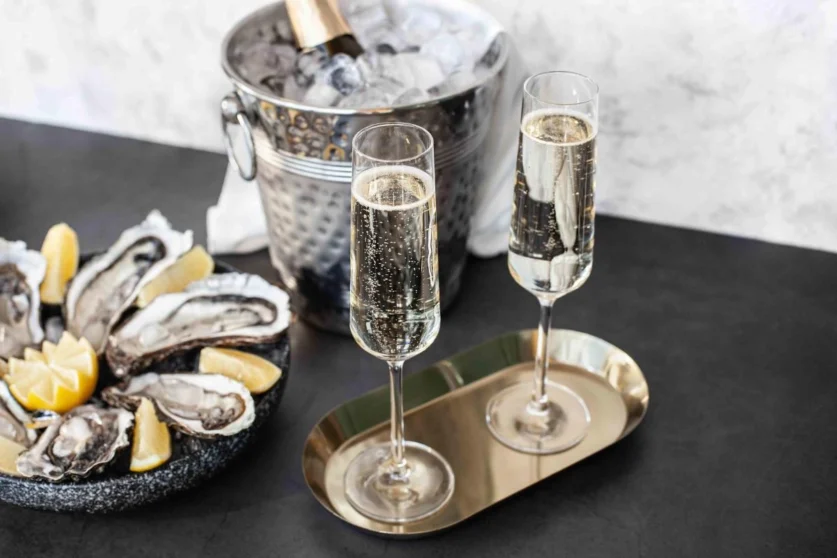
Versatile and food-friendly, pop the bubbly for any occasion.
Shvaygert Ekaterina / Shutterstock
Sparkling wine is far more versatile and food-friendly than conventional pairing wisdom lets on. Have you ever had a blanc de blanc Champagne with crispy fried chicken, washed down Italian mortadella with a frosty glass of Prosecco, or paired your New York slice with a sparkling ruby-hued Lambrusco?
Amanda McCrossin, a sommelier and host of the Wine Access Unfiltered podcast, is a keen advocate for popping corks when considering food pairings.
Related: A Case for Pairing White Wine With Beef
“Sparkling wine isn’t a one-size-fits-all category,” says McCrossin. “Like any other category of wine, sparkling wine is made all over the world and laden with choices that can work with various facets of our lives.” McCrossin will be hosting a session on pairing sparkling wines with everything at the Food & Wine Classic in Aspen this year, and pouring a variety of bubbles to help make her case.
McCrossin likens picking out a sparkling wine to planning out an outfit.
“You’ll quickly discover that Prosecco and Champagne, like pajamas and a cocktail dress, were destined for different things. Treat them accordingly,” she says. “You wouldn’t wear a cocktail dress to a football game or don pajamas to a work event.”
“[Prosecco] is the ultimate aperitivo wine — easy to drink and lovely to sip with food, especially the snacky kind,” continues McCrossin. “It isn’t built for long aging so it’s meant to be consumed in the moment. It isn’t meant to be taken seriously.”
McCrossin points to at the ancestral home of Prosecco, the Valdobbiadene region of Italy, and how the sparkling wine is enjoyed there. “Prosecco is consumed like water,” she says.
Pour Prosecco in carefree situations, alongside weekend lunches and seasonal salads, with snack dinners and grazing platters, or paired with Italian dishes like farinata or crispy gnocchi. Have a few glasses left in the bottle? Lend the leftovers to your pre-dinner aperitivo or post-dinner digestivo.
“Champagne demands a higher degree of attention when it comes to serving,” explains McCrossin.
She often matches Champagnes with more complex dishes. “Due to its complex aromatics and flavor profile, along with its aging potential, Champagne pairs well with a range of foods—from various cheeses to sophisticated dishes like scallops and lobster,” she details.
Similar to the overall category of sparkling wines, Champagne exhibits a wide range of variety, defying a uniform serving strategy.
Extra brut wines are a delightful match for salty or briny dishes like oysters, sushi, or even crispy, fried foods. The distinct mineral quality of a blanc de blancs shines when partnered with traditional favorites like caviar or crispy fried chicken. Older Champagnes, featuring notes of yeast, hazelnuts, and crème brûlée, complement foods like slices of Comté cheese or mac and cheese. McCrossin also enjoys pairing brut rosé Champagne, especially from Laurent-Perrier, with hearty, rich meat dishes.
If Champagne is beyond your budget, consider Cava and corpinnat. These Spanish sparkling wines are produced in the traditional method of Champagne and often share its characteristics but are more economical.
“The acidity of the wine should match or exceed that of the food it accompanies. Given Champagne’s high acidity, it’s nearly impossible to find a dish with which it doesn’t pair beautifully.” —Amanda McCrossin, sommelier and host of the Wine Access Unfiltered podcast“
McCrossin emphasizes one crucial principle in pairing sparkling wines with dishes. The wine’s acidity needs to be as intense as, or more so than, the food it’s intended to pair with. Considering the high acidity of Champagne, it’s a versatile choice that aligns well with virtually any dish.
However, McCrossin does advise to not overthink it too much. “Pairings don’t have to be fancy,” she says. “I love Champagne with potato chips — high fat and salt content goes brilliantly with sparkling, and even just a handful of nuts.”
Beyond stalwarts like Champagne and Prosecco, excellent bubbles can be found around the world. In England, producers like Wiston, Chapel Down, and Hattingley Valley lean into the region’s signature chalky soil, similar to those found in Champagne. Pair these bottles with fish and chips or British cheeses.
In South Africa, producers leverage the traditional méthode cap classique process to make Champagne-like wines that showcase South African terroir. Open a bottle to cut the costly fat of fried food — croquettes, arancini, or Southern-fried mushrooms.
Lambrusco, a deep red frizzante produced in Italy is perfect for pizza or anything covered with tomato sauce.
Then there’s pétillant naturel, made using the ancestral method, meaning, it’s bottled during the first fermentation, and one of the oldest styles of sparkling wine. Pét-nats are made all over the world from any grape variety, so there’s no typicity — many are wild and slightly fizzy, but beyond that, they can be bready, savory, and golden orange. This style of wine can also be cloudy, acidic, and the color of sunshine, or rich and rosy. Pairings can range from roast chicken to tinned fish or spicy Thai dishes.
But the most fun way to find out what works best? Try everything you can.
For more Food & Wine news, make sure to sign up for our newsletter!
Read the original article on Food & Wine.
Teen Arrested After Refusing to Cooperate and Consuming Vodka

BEDFORD – On the afternoon of Saturday, June 8, just after 4:00 PM, officers from the Bedford Police were dispatched to a residence on the 1000 block of 14th Street following reports of a drunk 16-year-old girl acting belligerently towards her parents.
Upon arrival, the police encountered her parents in the parking lot, who described the teenager as “highly intoxicated” and were seeking her arrest.
Police Officers Landon Jones and Capt. Kody Emmons located the young girl inside her parents’ car, where she appeared extremely upset, crying uncontrollably and speaking unclearly due to her slurred speech.
The police asked her to exit the car, however, she would not comply.
Captain Emmons had to remove her from the vehicle.
After being removed, the teen turned and struck Capt. Emmons in the chest. Officers placed the teen on the ground. She continued to be combative and began kicking Officer Jones in the leg above his knee.
She continued to struggle and attempted to pull away from officers.
The teen was handcuffed and put in leg restraints.
The teenager was put in the rear seat of Officer Sarah Haluda’s police vehicle and driven to the Bedford Police Department.
While at the station, the teenager was defiant and verbally confrontational with the police officers. She also expressed suicidal thoughts and at one stage, threw herself to the ground, repeatedly striking her head against the floor.
The teenager underwent a preliminary breath test, which showed her blood-alcohol level was 0.221 percent.
Given her severe intoxication and suicidal declarations, she was taken to IU Health Bedford Hospital for medical evaluation.
The parents discovered a bottle of Vodka in their teenager’s room.
Following medical treatment, the teenager was handed back to her parents and pledged to show up in court facing charges of unlawful consumption, two instances of battery on a public safety officer, and resisting arrest forcefully.
The Ultimate BBQ Beer: Discover the Perfect Brew to Pair With Any Dish

Summer is the ideal season for outdoor barbecues with delicious grilled dishes and fresh sides such as creamy potato salad, corn on the cob, and simple potato chips. The perfect pairing for these salty and savory treats is a refreshing cold drink, and for adults, a cold beer is often a favorite choice. However, choosing the right beer can be daunting for a busy host.
With hundreds of beer varieties worldwide, choosing the right one can be overwhelming. While it might be tempting to opt for a standard case of light beer, what if you or your guests prefer something with a bit more complexity? Felipe Diaz, Bar Manager and Somelier at Zingerman’s Roadhouse, shared some insights with Daily Meal about selecting the best beers for summer gatherings. Diaz emphasized that beer choice should focus less on matching the food and more on complementing the overall atmosphere of the event.
Read more: 26 Popular Vodka Brands, Ranked By Their Versatility
Felipe Diaz mentioned that understanding your guests’ preferences is crucial when selecting beer. For a group of gourmet food enthusiasts, Diaz might choose a beer that pairs well with the main dish, like a classic IPA such as Bell’s Two Hearted. IPAs, known for their hoppy and often bitter flavors, which might include notes of citrus, earth, and herbs, are refreshing choices for a summer barbecue. Not a fan of IPAs? Explore different types, like dry beers, which might suit your taste and enhance the event’s enjoyment.
On the other hand, sometimes you’re dealing with groups that are more laid-back and perhaps aren’t as familiar with specialty beers. “If the crowd is more casual,” Diaz says, “I’ll bring along an easygoing American lager, like Short’s Local’s Light Lager.” While you can go more upscale with a craft lgier, some of the most popular beers in America are in this style — take Miller High Life, a balanced beer with plenty of bubbles. Other crowd-pleasing beers include Corona, which is a smooth Mexican lager, or Heineken, which is a European-style lager.
Once you’ve selected the right beer for your barbecue, it’s time to think about the temperature, too. Most of us know that a beer that’s too warm can wind up tasting flat, and loses some of its hoppy flavor. At the same time, if you serve it too cold, you’ll mute some of the beer’s taste and aroma, as well. Typically, you’ll want to keep your beer between 33 and 55 degrees Fahrenheit, depending on the type of brew you’re serving.
With hot summer temperatures, this range can be tough to maintain, but Felipe Diaz has a suggestion: “For keeping beer cold over a long period of time, I use science. Add some salt to your ice; it’ll lower the freezing point, which means your ice melts more slowly, and keeps your drinks colder for a longer period.” Beer left on ice can reach as low as 32 degrees Fahrenheit, putting it right on the cusp of the ideal drinking temperature. It should warm up by at least one degree while your guests enjoy mingling with a bottle or can in hand.
Read the original article on The Daily Meal
Exploring the Majestic Canyons of Wadi Rum, Jordan: A Journey Through Time and Nature

Wadi Rum, also known as the Valley of the Moon, is a breathtaking desert landscape located in Jordan.
This area, designated as a UNESCO World Heritage site, is renowned for its towering sandstone mountains, narrow canyons, and ancient rock carvings.
Its distinctive terrain has not only attracted filmmakers but has also become a haven for adventurers seeking unique experiences.
Jeep tours in Wadi Rum offer an exciting way to see the desert’s vastness, including spots you can’t reach by walking.
You’ll see amazing natural arches, ancient inscriptions, and landscapes that shift colors through the day.
Lasting two to four hours, these tours are led by local Bedouins who share stories of their culture and the land’s history.
For those who prefer exploring on foot, Wadi Rum’s hidden canyons provide an unforgettable journey.
Trails like Burdah Rock Bridge and Khazali Canyon guide you through narrow gorges barely touched by sunlight.
These hikes vary in difficulty and require no special climbing abilities.
As you navigate, encounter ancient petroglyphs on the canyon walls, enriching your adventure with a sense of mystery.
To fully immerse yourself in Wadi Rum’s beauty, spend a night under its starlit sky at one of the many Bedouin campsites throughout the desert.
These camps provide traditional tents equipped with basic amenities for a comfortable stay.
As night falls, you’ll be treated to an awe-inspiring view of stars, unobstructed by city lights—a perfect way to end your day in this enchanting landscape.
Jebel Umm Ad Dami, Wadi Rum’s highest peak, offers panoramic desert views to Saudi Arabia on clear days. An early morning climb to watch the sunrise is a rewarding challenge.
The round-trip hike takes about three hours and requires good physical condition. Witnessing dawn break over Wadi Rum from this vantage point is an unforgettable sight.
Reflecting on the Chaos: 50 Years Since Cleveland’s Infamous 10-Cent Beer Night

The Plain Dealer’s front page coverage was extensive, spanning six columns with two headline decks, a format typically used for significant news stories and major events.
Take me out to the riot
Let us drink, drink, drink, for the home team,
If they don’t win, we’re to blame.
For it’s beer in a cup, at 10 cents a pop
At the old ball game.
CLEVELAND — Stories abounded last week here and elsewhere marking Tuesday’s 50th anniversary of the memorable 10-cent Beer Night at Municipal Stadium. Some of them cranked out the old saw speculating that, while the official attendance had been 25,134, in the retelling, the number of people who claimed they were there that night would total many times that.
Well, I was there, and I’ve got the bylines to prove it.
For some time, I had the uncanny ability to attend sports events that ended up having quite odd outcomes.
I happened to be at the Cleveland Browns Stadium during the incident famously known as “Bottlegate,” which took place on December 16, 2001, during a match against the Jacksonville Jaguars. That day, Cleveland fans famously threw a fit, launching plastic bottles at the officials and everyone nearby, resulting in a 20-minute delay with just about 40 seconds of the game left to play. expressing their disappointment.
I was also present at the old Municipal Stadium shortly before the notorious Beer Night. It was a regular game against Kansas City, but The Great Wallenda decided to walk a tightrope set up high above the infield before the game started. The umpires, perhaps jokingly, declared a new rule stating that if a ball hit the wire, it would count as a ground rule double. Remarkably, Vada Pinson hit the wire with what seemed like a normal infield pop-up, turning it into a double.
At another game, a vocal fan teased Albert Belle about his drinking issues with a shout, “Keg party at my house, Joey!” In response, Belle threw a baseball hitting the fan squarely in the chest, leaving an imprint of the ball’s stitches on him. Although I did not witness it firsthand, I wrote about the incident, commending Belle for his precision and hinting that the fan perhaps deserved it.
Returning to the eventful Beer Night – the scene was already set for chaos.
Only a week prior, the Cleveland Indians had clashed with Manager Billy Martin and his Texas Rangers in a fiery encounter in Texas. The renowned sports talk show host Pete Franklin had been stirring excitement for the Rangers’ upcoming visit to Cleveland. Although I worked as a sportswriter for the Lake County News-Herald, that night I was simply a fan, there with my brother and a college friend, ready to sip some lackluster 3.2% beer and watch the unfolding drama.
As expected by anyone familiar with the volatile combination of copious amounts of alcohol and intense sports rivalry, the result was utter chaos.
In the early stages, spectators behind the Rangers’ third-base dugout exchanged what seemed to be friendly jeers with Martin and his players. From my spot in the first row of the upper deck along the first-base line, the exchanges appeared harmless. At one point, Martin humorously waved a white towel as if to surrender.
Initially, the crowd was spirited yet manageable, but as more alcohol was consumed, the atmosphere deteriorated.
A woman unexpectedly kissed the home plate umpire, Nestor Chylak. Streakers appeared, and several attendees invaded the playing field, prompting security to intervene. Spectators began to hurl hot dogs and beer at the players.
By the middle innings, the scene near the Rangers’ dugout became hostile. People climbed onto the dugout roof, banging on it furiously, which angered Manager Martin. In a heated moment, he gathered gravel from the warning track and threw it at the fans behind the dugout, escalating the unrest.
The chaos intensified as fans started to throw objects other than food. I saw a man rush by with a disused beer bottle wedged in twin paper cups, hurling it a significant distance onto the playing field.
He went back for more ammo and the next time he came down, I threw out my arm to stop him and hit him in the chest. He was a big guy, and as he looked blearily at me, I thought the next thing to go over the side might be me. But he just headed a couple of sections away and threw more missiles toward the field.
I’ve seen it written that the Indians were charging toward a game-winning rally at the end. But from my memory, the Rangers had the game under control heading into the bottom of the ninth inning with a 5-3 lead, and it was the crazies who kick-started the comeback.
As bottles, chairs and anything else the fans could get their hands on rained down on the field, the Rangers pitcher got understandably rattled and the Indians tied the game at 5-5, before Chylak, the umpire crew chief, rightfully ended it with a forfeit.
I had my press pass with me, and as it became clear that things were going to end badly, I went over to the press box and offered to help Hank Kozloski, who was covering the game for the News-Herald. So I wound up doing stories from the umpires’ room and the visiting clubhouse. I saw longtime Plain Dealer baseball writer Paul Hoynes in there, then working for the Painesville Telegraph, who also started the night as a fan but quickly kicked into work mode, too.
I’ll never forget Chylak, a decorated veteran of the Battle of the Bulge, raging as blood ran down his temple from where he had been hit by a chair: “Those people were animals!” he said. “The last time I saw animals like that was in the zoo! The zoo!”
Martin, in the post-game locker room, was in barely controlled fury, describing why he grabbed a bat and led his team out to rescue his right fielder, Jeff Burroughs, who was being surrounded by fans:
“You’re damn right I thought somebody was going to be very badly hurt, that’s why we went out after Jeff.”
Then, as I wrote for the next day’s paper, Martin poured himself a mug of beer and studied the innocent-looking white foam that started it all: “It’s a sad day when a bunch of drunks can run on the field and make a team win or lose,” he said. “It looks like the fans just can’t handle beer night. It’s a real shame.”
A unique story that I haven’t encountered elsewhere is told by former Indians catcher Duke Sims, who recounted an evening out with his Texas teammates, Joe Lovitto and Rich Billings. They ventured into town the previous night.
During their exploration, they encountered a young woman who professed to be a witch and foretold their deaths the next night.
“We all laughed at her,” recounted a perturbed Lovitto after the eventful night. “But after tonight, maybe I’ll take people more seriously if they tell me they’re a witch. It seems she was somewhat right, wasn’t she?”
Ted Diadiun is part of the editorial board at cleveland.com and The Plain Dealer.
To reach Ted Diadiun: tdiadiun@cleveland.com
Have something to say about this topic?
* Send a letter to the editor, which will be considered for print publication.
* Email general questions, comments or corrections regarding this opinion article to Elizabeth Sullivan, director of opinion, at esullivan@cleveland.com.
If you purchase a product or register for an account through a link on our site, we may receive compensation. By using this site, you consent to our User Agreement and agree that your clicks, interactions, and personal information may be collected, recorded, and/or stored by us and social marketing and other third-party partners in accordance with our Privacy Policy.
Harmony Wine Walk: A Toast to Community and Support for the Local Library

HARMONY — Cool drinks, a light breeze and summer sun shined on the sold-out Harmony Wine Walk on Saturday, June 8, making it a successful fundraiser for the Zelienople Area Public Library.
With 14 alcohol vendors and several others selling food and other items, event coordinator Bekah Regan said they were expecting a fun, friendly evening around the historic town.
“The town of Harmony is really lovely to walk around, I think that’s the allure,” she said, saying they sold 450 tickets for the event. “And it’s all for the library, I think that’s a big draw for people.”
Regan said they raised around $19,000 during the eighth annual event.
Groups of people mingled together, exploring the towns streets in search of the boozy booths.
The walk is a yearly outing for sisters Stephanie Gordon, of Harmony, and Heather Tatton, of Pittsburgh, who confessed they arrived to the event later than expected.
“We actually bought the extended tickets, but forgot to come early,” Gordon laughed. “We both said, ‘It’s OK, it’s a donation.’”
Both said they were happy to support Zelienople’s library.
“We’re huge readers,” Tatton said. “It’s a great idea, I hope it (raises) a lot of money. It’s such a cute town.”
Vickie Dellaquila, of Jackson Township, said she and her friends are part of a neighborhood wine club, and were excited to attend the walk together.
“I would say we’re kind of connoisseurs,” she said. “We get together and try wines and cheese once a month while our husbands play poker.”
Donna Weston was part of the group, and said she was excited to be there.
“I’m a frequently at the library, so I feel this is a positive thing to give a contribution in support of them,” she said.
Stacie Schneider, of Zelienople, said she was eager to support the library since her nephew is always taking part in their programs.
“My sister has an 18 month-old, he’s into all the books and programs there, so I’m happy to be supporting it.”
She added that she was impressed by a jalapeno wine she tasted.
“I came last year,” she said of the walk. “It’s just a great selection, lots of vendors.”
Overall, Regan said the fundraiser does just as much for the borough as it does for the library.
“Our goal is to sell out tickets and have a good time, and introduce people to the town of Harmony,” she said.
JoJo Siercicio Defends Herself Against Online Troubles: Tackles Trolls Amidst Pride Performance Controversy

The concert series also included headliner Ricky Martin as well as Muna and the stars of ‘We’re Here’
By Marc Malkin
Senior Editor, Culture and Events
JoJo Siwa put on quite the colorful show at L.A. Pride in the Park on Saturday night at the Los Angeles State Historic Park.
Not only did the former “Dance Moms” star end her performance by drinking from a vodka bottle (it’s not known if it contained real alcohol or if it was just water), but she also dropped plenty of f-bombs.
“I have performed in front of six-year-olds louder than you,” she ranted at the crowd before pointing to a child being held on someone’s shoulders near the front of the stage. “In fact, there is a six-year-old right there — why the fuck are you here? I love it. I’m so here for it. You’re awesome, dude. My point is don’t let that superstar be louder than you guys. Lemme hear you make some fucking noise.”
She went on to say how much she loves performing in front of a live audience. “You guys aren’t the dicks online,” she said. “Not going to lie, I have to deal with a lot of them online. I woke up this morning and, as one does, I opened my phone and the first thing that came up was a picture of me performing back when I was in London a couple of days ago.
“Some guy – I stalked his page, he was definitely straight…This guy commented, and this was a new comment for me,” Siwa continued. “It wasn’t about a dance that I do. It wasn’t about my hairline, it wasn’t that I’m a 5-foot-9 giant toddler. It said, ‘This man needs to be stopped.’”
Siwa insists she didn’t let the remark get to her because she realized two things. “Number one, my dick was bigger than his and number two, I fucked more girls than him,” she cracked.</
p>
Happy Pride! @itsjojosiwa vs. a troll.
JoJo wins. pic.twitter.com/KGXrOJYVcf
Headliner Ricky Martin’s set was a high energy performance of his greatest hits that included outfit changes and plenty of bon-bon shaking from him and his sexy dancers.
“This is wonderful,” Martin said. “This is going to be one special night. I could feel it…It’s a whole community from all walks of life together, joining forces, representing and letting the world know how beautiful it is to love the way we love and this is how we need to do it. We need to be always together and fight for each other. We’re warriors. We’re fighters. I know we are.”
About last night. @ricky_martin at @lapride: “We are warriors. We are fighters.” @Variety #variety
L.A. Pride in the Park’s lineup also included “We’re Here” hosts Jaida Essence Hall, Sasha Velour, Priyanka and Latrice Royale, as well as Muna, Isaac Dunbar, ADIV, Ryan Satyr, Lady Londyn, Hason, RaiNao, Tokischa, Lykke Li and DJ Alex Chapman. Frankie Grande and “Hacks” star Mark Indelicato also made onstage appearances.
Giant Earthworms and Their Impact: Transforming the Landscape of the Isle of Rum

June 9, 2024
This article has been reviewed according to Science X’s
and policies.
Editors have highlighted
the following attributes while ensuring the content’s credibility:
fact-checked
trusted source
Written by researcher(s)
Proofread
by Kevin Richard Butt, The Conversation
Renowned for a thriving and intricately studied population of around 900 red deer, the Isle of Rum, part of Scotland’s Inner Hebrides, is often considered an outdoor laboratory for scientific research. But the earthworms on Rum are equally remarkable. These invertebrates act as “ecosystem engineers”, actively shaping the landscape, often after humans have left their mark on this remote island.
My investigations over 30 years have uncovered how people have influenced the current fragmented and uneven distribution, diversity and abundance of earthworms on this national nature reserve.
While taking my geography students on field trips to Rum in the mid-1990s, I realized there was scope for research on earthworm ecology. One of my Ph.D. students was studying soil development here and she quickly alerted me to differences in earthworm numbers found below different species of trees planted in the late 1950s. More worms lived below birch and oak trees than beneath pine trees or on unplanted moorland. This discovery spurred me into action.
Rum’s human history goes back 9,000 years. Early humans came here to collect bloodstone, a flint-like mineral used to make arrowheads and other hunting or cutting tools. The island was deforested by early humans and the wet climate (with more than 2m of rain per year) led to the leaching of soil nutrients. The resulting poor-quality acidic soil supported moorland plants and low numbers of just three earthworm species.
If nothing else had happened to Rum soils, then this would be a very unexciting place to undertake research on earthworms.
Later settlers enhanced the soil on the island to sustain themselves as tenant farmers along certain coastal regions. They utilized kelp seaweed to improve the soil fertility. Around 200 years ago, these industrious individuals were evicted from their homes on Rum (and extensively across Scotland) during the events known as the “Highland clearances”.
In areas of Rum such as Harris, Dibidil, and Kilmory, one can still see the legacy of their agricultural efforts. Known as “lazybeds,” these patterns of ridges and furrows mark where the land was manually tilled to cultivate potatoes and other crops, with the furrows enabling drainage. Even two centuries after the abandonment, these soils remain more fertile than the nearby lands, supporting a higher number of earthworms.
In a deserted area known as Papadil, a brown forest soil has developed beneath forests planted a hundred years ago. Within these woods, my colleagues and I discovered sizable earthworm burrows measuring about 1cm in diameter. On this island, devoid of badgers and moles and with an ample supply of leaf litter as food and minimal human interference, we encountered the largest Lumbricus terrestris ever reported in the UK. Weighing over 13g, roughly three times the typical weight for this species, these earthworms could be up to ten years old. Discovering these was truly thrilling, and we made sure to return them to their soil, where they hopefully continue to thrive.
For over a hundred years, the elite owners utilized Rum as an exclusive hunting and angling preserve, effectively rendering it the “Forbidden Isle” during the late 19th to early 20th centuries.
The construction of Kinloch Castle in 1897 by the textile magnate George Bullough, at the behest of his wife, Lady Monica, who desired to cultivate roses, marked a significant alteration to the landscape. To support the garden and enhance the surroundings, they brought in 250,000 tonnes of high-quality soil from Ayrshire. Though they resided in the castle merely for six weeks annually, their actions profoundly impacted the local underground ecosystem.
This newly introduced soil brought earthworms to the area surrounding Kinloch Castle. Presently, the region supports 12 species of earthworms that prefer soils with neutral pH, flourishing at significant levels (200 worms per square meter). Our studies conducted by sampling at 50-meter elevation intervals from the sea level up to Hallival’s peak illustrate that the richness and abundance of these worms conclude sharply at the estate’s boundary where the added soil ends.
Aside from human intervention, natural activities also influence soil characteristics. On the higher slopes of Rum, between 500-800 meters, patches of vibrant green vegetation are visible amidst the rocks. These areas, known as “shearwater greens,” emerge due to the nesting activities of Manx shearwaters.
Pairs of these black and white seabirds burrow into the hillside to raise one chick each year, before beginning their long-distance migration towards South America. The verdant shearwater greens are fertilized from above by the feces of the adult birds before they fly off to forage for small fish such as herring and sprat to feed their chicks.
More nutrient-rich feces from the digested fish are also produced by the chicks in the burrow below ground, so soil enrichment is from a marine source. This supports grass growth and more earthworms—the same three species found on the moorland, but in much greater numbers.
On low-lying moorland, fenced plots keep deer away from trees that were planted in the 1950s and 1960s, just after Rum became a national nature reserve. Now, these protected trees provide roosts for songbirds, and the soil beneath them is rich with earthworms as the tree leaf litter adds nutrients to the soil. These plots have triggered a small-scale reafforestation project which could change this island landscape, its soils and its many earthworms.
Rum has yielded some remarkable earthworm findings, often linked to human activities or dynamic natural processes. As earthworms engineer this ecosystem and naturally derived nutrients get added, soils change. Longterm monitoring on Rum could help us better understand landscape transformations and soil health, here and elsewhere.
Provided by The Conversation
This article is republished from The Conversation under a Creative Commons license. Read the original article.
1 hour ago
Jun 8, 2024
0
Jun 8, 2024
0
Jun 6, 2024
0
Jun 6, 2024
1
1 hour ago
6 hours ago
21 hours ago
Jun 8, 2024
Jun 8, 2024
Jun 8, 2024
Jun 7, 2024
Jun 7, 2024
Jun 7, 2024
Jun 7, 2024
May 12, 2021
Apr 12, 2024
Sep 11, 2023
Apr 16, 2024
Mar 16, 2022
Feb 8, 2024
Jun 7, 2024
Jun 7, 2024
Jun 7, 2024
Jun 6, 2024
Jun 6, 2024
Jun 6, 2024
Unveiling the Distillation Process: The Secret Behind Tito’s Vodka

The frequency of distillation for vodka often correlates with its purity. For example, Tito’s Handmade Vodka undergoes distillation six times, underscoring its place as a pure and premium spirit.
In basic terms, distilling alcohol involves concentrating alcohol from an already alcoholic mixture. Vodka can be produced from various sources such as potatoes or fruits, though grain is most common. Initially, this creates a beer-like alcoholic grain liquid. This is distilled when the ethanol alcohol, which has a lower boiling point than water, evaporates first. The vapor passes through the still, cools down, and recondenses into a liquid with a higher alcohol concentration. Increasing the number of distillations typically increases the alcohol by volume percentage in the final product.
Many distillers believe that multiple distillations result in a purer spirit by removing unwanted compounds that could cause off-flavors, while others emphasize the importance of high-quality ingredients. For instance, Grey Goose distills its vodka just once. Tito’s opts to distill six times, aiming for a distinctly clean flavor, achieving a 40% ABV.
Read more: The 40 Absolute Best Cocktails That Feature Only 2 Ingredients
Spirits can be distilled in either a pot still or a column still. The latter has plates that the spirits pass through; its vapors condense each time and more unwanted compounds get stripped away, leaving that more concentrated alcoholic solution. Some large distillers use these column stills because they can run continuously, producing large quantities of liquor with each plate offering its own mini-distillation. A true distillation means an entire run through the still, as in going through the distillation process two, three, or, as is the case with Tito’s, six times.
Distilling in a pot still as opposed to a column still gives spirits more flavor. While you want a spirit completely clean of impurities, that doesn’t mean vodka has no flavor. It’s a neutral and versatile spirit, perfect for mixing into cocktails — that’s why vodka is one of the liquors every bar cart needs. But distillers often pursue a unique profile with, say, subtle notes of grain. There are plenty of popular vodka brands to choose from, but Tito’s really sets itself apart not just with its six distillations, but in the way it runs those distillations. Tito’s uses a pot still for distinctive flavor even though this method is more labor-intensive. That means they manually run their vodka through the still six times, creating a clean spirit that showcases the sweet, salty notes of the corn it’s made with.
Read the original article on Tasting Table