Beer-articles 1026
Businesses Gear Up for April’s Total Solar Eclipse with Special Celestial-Themed Donuts and Beer

Eclipse-themed beer. Jewelry and ornaments. And doughnuts that capture the sun’s disappearing act with the help of buttercream frosting.
With April 8’s total solar eclipse right around the corner, businesses are ready for the celestial event that will dim skies along a generous path across North America.
There are oodles of special eclipse safety glasses for sale, along with T-shirts emblazoned with clever slogans and other souvenirs — just like the last time the U.S. got a big piece of the total solar eclipse action in 2017.
Hotels and resorts along the prime path are luring in visitors with special packages and Southwest and Delta are selling seats on eclipse-viewing flights. Cities, museums and parks are staging watch parties to draw in tourists as well as residents.
“This is a special event and … the travel industry certainly is in a very good spot,” stated Jie Zhang, a marketing professor at the University of Maryland’s business school. She mentioned that this eclipse mania comes at a moment where consumers are steadily increasing their expenditure on fresh experiences.
As the eclipse day approaches, it is expected that more unique products and deals will emerge from nationwide brands. An example is Moon Pie’s “eclipse survival kit,” a package consisting of four mini versions of the chocolate treat and a pair of eclipse sunglasses.
So far, small-scale enterprises located along the 185-kilometer-wide path of the total solar eclipse have taken the initiative. E-commerce platforms and local traders have presented a range of inventive, limited-edition merchandise like earrings, infant outfits, decorations, pastimes, banners, and more.
Certain towns and entrepreneurs have been expecting this astronomical phenomenon and the massive audience for years.
Following the 2017 eclipse, Sam McNulty, co-founder of Market Garden Brewery in Cleveland, marked his calendar. The city, being in the path of this year’s eclipse, is poised to experience almost four minutes of darkened sky.
In the previous year, McNulty and his team came up with a unique idea – brewing a hazy IPA they named “The Totality” to pique interest in the eclipse. Their effort paid off when the brew debuted on tap, garnering immense interest. Soon after, a local grocery store, Heinen’s, proposed a collaboration to can the brew.
A post shared by Market Garden Brewery (@marketgardenbrewery)
Within the following weeks, McNulty said that “thousands and thousands” of cans are slated to flood the market. The ambitious endeavor was prompted by the rarity of the eclipse event. In fact, Cleveland won’t find itself in the path of a total eclipse again before 2444.
“I don’t want to have to wait 420 years to brew the next batch of cans,” he joked. “So we made a very large one this time.”
The eclipse-themed beverages don’t stop at beer. Big Cuppa, a coffee shop in Morrilton, Arkansas, also has a full eclipse menu with a handful of specialty drinks. Its “Moon Pie Frappa” is a blended Moon Pie drink flavored with dark chocolate and toasted marshmallow.
Big Cuppa co-owner Joseph Adam Krutz said that he’s excited to greet customers and the many new faces set to travel through town next month. Krutz said his shop has been gearing up for a while along with other businesses in downtown Morrilton. He drives by a countdown clock each day.
“We’re prepared. Bring it on,” Krutz said.
And don’t forget the snacks. In Ohio’s Butler County, a shop named The Donut Dude will feature an “Eclipse Donut Special” that displays the eclipse’s phases as the sun hides behind the moon.
The special will be available later this month and includes seven filled-doughnuts with rolled buttercream, two galaxy-themed cake doughnuts and safety glasses for customers to enjoy the event while munching.
“We’re expecting a lot of excitement,” says co-owner Glen Huey.
Given that the doughnut shop is not open on Mondays, Huey is excited about watching the spectacle as it moves over his town between Cincinnati and Dayton.
In the U.S., Texas anticipates a surge of tourists due to its optimal viewing opportunities for clear skies. Eateries in the quaint town of Grapevine are preparing exciting offerings for this occasion, including a “Blackout Dinner” at Hotel Vin and an enticing “Solar Eclipse Shake” at Son of a Butcher.
Businesses situated along the path of totality are eagerly planning special events leading up to this celestial phenomenon.
The esteemed Cayuga Lake Wine Trail of New York has a plan to celebrate the eclipse weekend commencing April 8. They are organizing “Sips to the Eclipse” wherein guests would have the privilege to visit 10 distinctive wineries for a delightful tasting experience. An allure of varied additional attractions such as special eclipse eve tarot card reading, delightful slushies, and appetizing half-moon cookies are on the anvil.
Katherine Chase, the executive director of the wine trail, reported advance planning of the promotion to optimally leverage the influx of people expected to visit the Finger Lakes region for the eclipse.
“The wineries can go as big or as little as they’d like to entice folks to come,” she said.
Celebrating St. Patrick’s Day: Embracing the Irish Spirit with Beer Blessings
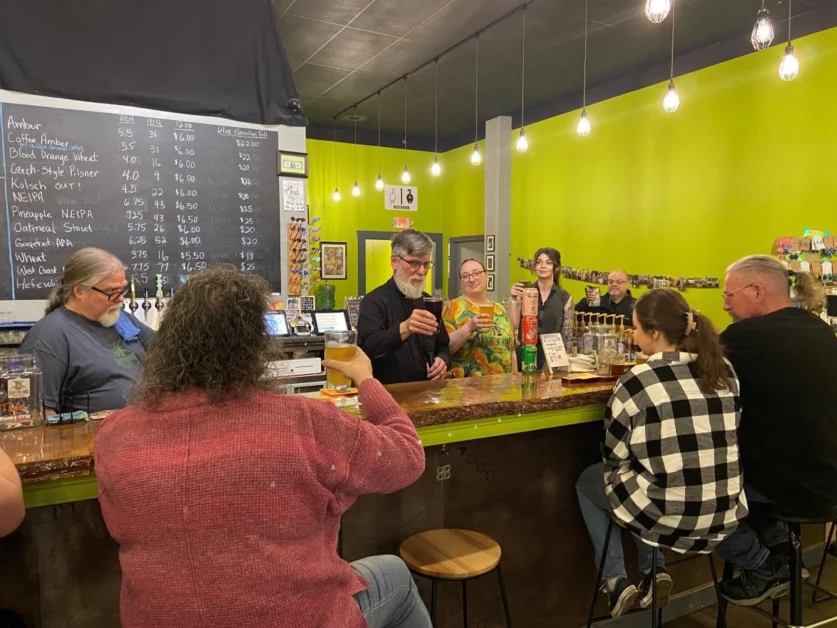
A cheer erupted from the onlookers gathered around the Tasting Room of Louisiana’s bar on Saturday when Father Steve Brandow sipped the beer he had just blessed. This action officially inaugurated pouring for the patrons who were eagerly awaiting with tickets.
This was one of two beer blessings performed by Brandow in the vicinity on Saturday, one day prior to St. Patrick’s Day.
This tradition of blessing has been a long-standing one at the Tasting Room situated downtown Alexandria pub, even before it came under the ownership of whiskey sommelier and current proprietor, Melissa Scarborough. Back in the day, it was known as Finnegan’s Wake and the blessings started around the mid-2000s.
According to Brandow, beer is blessed as it is considered a food item that forms an essential food group for beer enthusiasts. In the same way that some individuals express their gratitude to God for everything in their lives, they also thank Him for the beer.
“It’s a social event,” he said. “Catholics have always been social people.”
‘A sign of our community’: Blessing of the Beer kicks off St. Patrick’s Day celebration at The Tasting Room of Louisiana
‘Big ol nerds’: Fighting Hand Brewing Company pays homage to Dr. Who
Over at a table, Jerry Liberty and Betty Chavez, both sporting green shirts and green and white beads that had been left on tables, snapped cellphone photos of Jody Skeltoe, who was wearing a green hat and multi-color glasses. The women hail from New Mexico, visiting friends who live here.
They mentioned their enjoyment and anticipation for a “crawdad” boil scheduled for later on Saturday.
The one responsible for the crawfish boil is Bob Pulaski, who made his presence known with a leprechaun hat, green shirt and red kilt, stationed by the bar.
Pulaski acknowledged his wife as the originator of the boil – a tradition dating back many years, he claimed.
His role? “To sip on beer, leading up to my cooking responsibilities.”
Hours later, Brandow made his way to Pineville’s Fighting Hand Brewing Company for the second blessing of the day. Although the brewery has been operating for three years, this is their second time hosting a blessing of the beers.
Standing behind the bar and flanked by owners Chris and Tiffany Lindsey, Brandow invited the gathering to join him as he shared about the first people to craft beer.
However, it was not what people today recognize as beer. It was purely wild grain mixed with water.
“They hadn’t tamed grain yet. That development would happen soon thereafter, but after they relished the first beer, they decided they needed to recreate it, whatever it was,” he narrated, prompting laughter from the crowd.
And he provided them a succinct recounting of St. Patrick’s story and accordingly named them honorary Irish.
“Welcome to the family. If you’re not already Irish, it’s high time.”
Tiffany Lindsey expressed the sentiment that the blessing was an enjoyable event for the community, and since Brandow was a regular participant, he was the probable choice to perform the blessing.
“Upon hearing about other locations engaging in similar celebrations, it occurred to me that we already produce beer,” she pointed out. “Let’s participate.”
This article originally appeared on Alexandria Town Talk: St. Patrick’s comes to Rapides with blessings of beers at pub, brewery
Exploring the Connection between St. Patrick’s Day, Green Beer and the Salvation of American Democracy

There are a few important points to be understood from the outset. For one, green beer has always been a poor choice and lacks any redeeming qualities. Furthermore, I am cynical about whether even St. Patrick in his heyday could banish all the political snakes from present-day Washington. The history of St. Patrick’s Day itself has its significant blemishes, specifically concerning inclusivity.
However, despite these issues, I propose that there is something inherent in America’s observance of the holiday that reflects our nation’s strengths – qualities we can and should emphasise, especially as we enter an intense, merciless election year.
Please don’t mistake this for the enamoured ramblings of a die-hard St. Patrick’s Day enthusiast. I grew up with a recognisably Irish name and had a decidedly lukewarm attitude towards a celebration that perpetuated so many stereotypes and misconceptions. As a young teenager well-versed in sarcasm, I would jokingly claim it was my duty to be Irish every day of the year, barring March 17th. I also witnessed many attempts to categorise Americans based on ethnic, religious or racial differences, which often perpetuated divisions rather than fostering a healthy sense of pride.
Yet, my perspective has softened with time. What sparked this change? Partly, a deeper understanding of history. St. Patrick’s Day parades have been a part of American tradition for an incredibly long time – the first of them took place well before the Declaration of Independence was signed. Initially a display of Irish pride (sometimes bordering on rebellion), these parades have grown increasingly inclusive over the centuries. Like the greatest parts of the American story, they have opened their ranks to more and more people, whether as parade participants or spectators.
This didn’t come easily, and even involved a significant Supreme Court case regarding access for LGBTQ groups. It may seem like the Supreme Court makes all the decisions nowadays, but while that specific decision cemented the right to limit parade participation, it wasn’t the final say. What tipped the scales were shifting perspectives and the courage of political and business leaders to advocate for inclusion.
Witnessing multiple St. Patrick’s Day “miracles” also played a key role in changing my attitude. One of these is a longstanding breakfast tradition in Boston where Republicans and Democrats put their political differences aside and choose humor instead of stinging political remarks. Humor plays a vital role in the magic of St. Patrick’s Day. Jokes that spite others contribute to our shared angst and resentment. Meanwhile, laughing at ourselves and each other is what mends fences and builds bridges.
I’ve been to several parades, including a large one in my conservative town in Florida, where I’ve seen a diverse group of Americans happily marching and cheering for each other. Community celebrations are quite powerful and beautiful – and regrettably rare in present-day America.
Unfortunately, holidays have become increasingly complicated and politicized recently. We must tread cautiously when extending heartfelt greetings, like the “Merry Christmas” vs. “Happy Holidays” dilemma. Fortunately, St. Patrick’s Day has remained immune to this, and it’s crucial we maintain this. It has no sides to pick, no scores to keep, and isn’t about political colors — it’s just about varying, often flamboyant, shades of green. Just be yourself, whether you’re celebrating Irish culture or the arrival of spring. St. Patrick’s Day is a representation of America at its most authentically superior and down-to-earth.
We urgently require more special occasions like these when we set aside our ‘us against them’ mindset and unite as one. These are moments when we can dress up in goofy costumes, avoid discussing politics, and honor the diverse contributions that make up the American family. This perspective and the principles it represents should be emphasized every day.
Election day, for instance, could be seen as a celebration of these elements of the American spirit. Yes, we will end up voting for varied candidates, but we could also perceive it as a chance to collectively express our gratitude for the liberties we have and acknowledge those who made substantial sacrifices to ensure these liberties for us. The takeaway is that occasions like St. Patrick’s Day highlight our capacity to celebrate collectively without focusing on our disagreements, grievances, or anger. If we can achieve this (though imperfectly) even for a single day, it implies we can replicate this more regularly. I firmly believe that for America’s continuing evolution to succeed, we must muster the wisdom and bravery to accomplish just that.
Just a heads up, if our volatile political environment is tempting you to have green beer or even something stronger to dull the senses, you should first check out Citizen Connect. I am a co-founder of this non-partisan online platform, which lists 600 organizations intent on finding common ground.
Columbus Ranks as Top 5 Beer City: Unraveling the Love for Beer Here!

COLUMBUS (WCMH) – This is a story about beer and a town that loves it.
Columbus was recently rated as the No. 3 beer city in America, according to a poll from USA Today. It begs the question, why Columbus?
Is it the German heritage in the city? Is it the vast influence of a massive college campus in the city?
“We don’t have beaches, we don’t have mountains,” said Collin Castore, owner of Seventh Son Brewing in Columbus. “But craft beer has kind of filled that niche that people can really identify with it and enjoy it. And it’s become a part of what Columbus is.”
Pi Day deals: Discounts from Burger King, Crumbl, Domino’s, Marco’s Pizza and more
In the 2010’s, Columbus saw something of a craft beer boom. Well-known breweries like Seventh Son, Land Grant, Wolf’s Ridge, and North High Brewing all opened more than a decade ago. They’re all still brewing, and it’s still a sweat-intensive business.
“We’re kind of pushing each other to really be not just good for Ohio breweries, but good for anywhere in the country breweries.” Castore said. Beer is a big business in Ohio. According to the Ohio Craft Brewers Association, Ohio is home to 430 breweries, supporting nearly 14-thousand employees. The OCBA says craft beer in Ohio is a $1.3B business. Brewers say keeping it local is their appeal.
“The people making the beer are just through the window and telling that story really helps kind of bridge that gap for people,” said Adam Benner, co-owner of Land Grant Brewing. “They will pay a premium because they know it’s it is locally crafted. It is something that they care about.”
“Beer just brings people together.” said Seventh Son brewer Chris Carter.
Carter is now planning to open his own brewery, Honest Friend Brewing, later this year.
“The business side is everything. You have so many breweries that are making fantastic products. What are you going to do to stand out?” he said.
Local breweries are facing a saturated market and some grim financial realities. According to a study by the Brewers Association, last year just over 400 breweries opened across the country, but just under 400 closed.
“We’re a very mature industry now over the course of the past 20 or so years,” said Mary McDonald of the Ohio Craft Brewers Association. “People who are going to open a brewery now need to be very deliberate and have a really good business plan.”
Benner says Columbus saw that play out in his home market.
“We saw a decent amount of local breweries here in Columbus shut their doors or transfer ownership. And a lot of people are like, is this the bubble of craft beer?” he said.
Central Ohio restaurateur to launch new create-your-own stir fry eatery
Consumers are the ones who bear the brunt of the financial strain. “With rising costs, prices have necessarily increased,” says Bob Szuter, the co-founder of Wolf’s Ridge Brewing. “This effectively alters the experience of dining out or grabbing a drink.”
Despite the competitive landscape, many brewers insist that the industry continues to be one of collaboration and camaraderie.
“Indeed, the brewing industry has a very cooperative and fraternal atmosphere. However, we are all vying for the same limited space on the shelves of large grocery stores,” states Gavin Meyers, co-founder of North High Brewing.
“If you brew incredibly high-quality beer and establish your business in an area that, in my opinion, lacks adequate clientele, then you have the opportunity to build quite a successful operation.”
For the latest news, weather, sports, and streaming video, head to NBC4 WCMH-TV.
Top 30 Unique Gift Ideas for Beer Enthusiasts in 2024

The best gift to buy the beer lover in your life is obviously beer. You knew that. But what kind? They could be a craft connoisseur or a domestic diehard. Perhaps both. Or maybe an international option is more of a treat. There are a lot of choices. It’s probably wisest to leave the beer buying to the actual beer drinker and gift them something else.
So, consider what’s essential when drinking a beer. It has to be cold. Freshness is preferred. Company and location matter too, because beers in the backyard, on the beach and at the bar each offer something different. With those ideas in mind, we found the best gift ideas for every kind of beer drinker you know, including monthly subscriptions to rare beers, coolers to maintain just the right chill, glassware to accentuate every tasting note and more.
If a beer drinker had to pick one glass to drink from for the rest of their life, this would probably be it. It brings out the best taste and aroma in any beer — from IPAs to sours and everything in between.
Every beer lover has stared into the cooler at a store and been frozen by the plethora of brews from which to choose. This subscription, which lets members pick their favorite styles and cancel at any time, helps alleviate the overwhelming decision by sending award-winning craft beers to their door.
Drinking from a cup is superior to drinking from a can. The airflow improves and the brew’s aroma is more easily enjoyed. This little device safely lifts the top off any can without leaving any sharp edges behind, meaning any can can become a cup.
This pup was trained well. Each time it removes a bottle cap from your beer, it keeps the cap in its mouth until you’re ready to throw it away.
A warm beer is a worthless beer. Our favorite soft-sided cooler can help avoid such a travesty with space for 30 cans. It won in our testing because it boasts the compactness and portability you’d expect, but in a durable frame usually reserved for bulky hard-sided coolers.
Name a better duo than a warm soft pretzel and a cold beer. This box of puffy pretzels includes four varieties of salt — truffle, cheese, chili lime and traditional — to pair with whatever your beer lover is sipping.
Related article: The 58 best food gifts for every budget
Part glassblowing studio and part craft brewery, the Pretentious Craft Co. based in Knoxville, Tennessee is an internet favorite for its unique glassware. Its online shop has plenty of different shapes perfect for beers, but I’m especially drawn to this wobbling glass great for just about any drink.
Yes, it’s a splurge. But beer lovers tend to drink in numbers, and there’s no hosting flex quite like serving from a kegerator. This model can fit multiple Cornelius Kegs or a Half Barrel Keg.
These flight boards are perfect for bringing the brewery experience home. Choose from mini pub-style glasses or mini tulip glasses, and submit a design to get your board customized.
Spirits, bitters, citrus and soft drinks are commonly used in mixology, but don’t sleep on beer’s ability to elevate a cocktail. This hardcover book contains more than 50 recipes that combine beer with the likes of gin, whiskey and much more.
Related article: Give the merry with these best alcohol, wine and barware gifts
If your beer lover prefers Guinness, then you probably know the Irish classic has to be served right. This tool that ensures a proper pour is technically only compatible with particular cans that aren’t yet sold in the U.S. … but look hard enough online and you’ll find a hack to utilize it on any Guinness nitro can.
Black and Tan, Black Velvet or Snakebite — all these drinks can be easily layered using this tool. First, pour your bottom ingredient, then place the disc on the glass, and then delicately pour the top layer, letting it slowly trickle through the holes.
Choose from any of the 50 states for this plywood cutout that is specially designed to accommodate your bottle caps. It’s an innovative solution for anyone who loves to collect memorable tokens from their favourite local beers. What’s more, each cutout comes with extra holes for uncomplicated wall mounting your display in a man cave.
This bottle opener, hand-built by a father-son pair in Oklahoma, carries out its task with one essential provision: it won’t bend or harm the cap in any way. It’s a must-have item for collectors.
Meet the ultimate koozie. It snugly fits both 16-ounce cans and 12-ounce cans, coming with a chillable gel pack for the smaller cans, and can even accommodate a poured pint with its leakproof lid that our editors endorse.
Does the beer enthusiast in your life need hand-stitched coasters? Maybe not. But could one of these competitive sets from Smathers & Branson significantly upgrade their beer corner decoration? Absolutely.
I received one of these compact jackets as a gift years ago, and it has been my preferred koozie even as my collection has expanded. It’s entertaining, keeps my beverage chilled and its sleeves double up as handles as I drink. Bonus: Puffin offers many other styles, including leather jackets, space suits and rain jackets.
The concept of home brewing appears enjoyable — but it can be quite a task. Pinter tries to make the process easier by providing all the ingredients in a package they refer to as a Fresh Press. Simply pour it into the Pinter, add water, and after a couple of days, there are 12 pints of beer ready for you.
There is a plethora of excellent drinkware that looks attractive and keeps beer chilled, yet it seldom is as transportable and storage-friendly as these stackable pints from the company that produced the world’s most famous water bottle.
Related article
How to (finally) clean your water bottle, according to experts
A shower beer simply hits different. This silicone can holder sticks to any shower wall without additional adhesives or mounts. The brand also makes some of our favorite
This complex wall art traces the origins of every beer style back to lagers and ales. It’s fitting decor for any home bar — and a useful explainer for anyone tired of having to tell their friends about the difference between an IPA and a stout.
If their beer takes up too much room in the fridge, this highly rated beverage cooler can give those six-packs a home away from all the groceries. Its glass door looks great and its shelf arrangement and temperature can be adjusted to preference.
Your recipient will benefit from this set of four glasses designed for different styles of beer including IPA, stout, wheat and barrel-aged ale.
If the beer enthusiast lives in a place where getting home from the bar is an expense, an Uber gift card can contribute to their safety and financial ease.
Northern Brewer offers homebrewing starter kits with prices ranging between $50-$700. This specific mid-range set includes all the essentials for brewing and bottling beer at home, featuring the ingredients for a Kama Citra Session IPA.
Enjoying a beer in the topmost seats of your favourite ballpark during a warm summer night is undoubtedly the best experience. These pint glasses, designed with 30 MLB parks, provide the second best alternative right at home.
Growlers frequently provide an ideal solution for individuals who wish to bring home beer from a brewery without opting for a bottle or can. This wooden tap is perfect for sharing some beers amongst friends. It’s accompanied by a 64-ounce glass growler, and it’s quite easy to clean, simply run some warm water through it after every use.
In our experience, this cooler has performed exceptionally well amongst a variety of others. This present is certainly one that will continue to be valuable for numerous summers due to its sturdy hard shell and ability to hold 28 cans alongside a substantial quantity of ice.
The Original Craft Beer Club aims to showcase the diverse array of beers from across the country. You have options to choose from two different U.S. breweries for 12 or 24 beers featured in each shipment. It also includes tasting notes on the included brews. Gift memberships begin from a duration of three months.
For those who truly love beer for the taste and not the buzz, one of our favorite non-alcoholic beers is worth the try. Our reviewer has seen friends mistake its hoppy, citrusy taste for the real thing — it’s that good.
Related article: The 29 best gifts for wine lovers in 2024, according to experts
Expert Advice: The Top 4 Non-Negotiables for Brewing Beer at Home

Since the Neolithic revolution, when the implementation of agriculture paved the way for human civilization, society has been inextricably linked to the art of brewing beer. Little has changed over the ensuing millennia, as creating new brews and experimenting with recipes remains a popular business (and hobby) in the 21st century — some people have even turned Lucky Charms into beer, for example.
Because beer is made through a biochemical process called ethanol fermentation, in which yeast converts sugar into alcohol and carbon dioxide, a successful batch requires specific conditions. Failure to maintain these conditions can result in the beer becoming contaminated with mold or bacteria. In an exclusive interview with Mashed, co-owner and head brewer of Spice Trade Brewery + Kitchen Jeff Tyler helped hobbyists avoid the biggest mistakes people make when brewing beer by explaining four non-negotiables: cleaning, sanitization, healthy yeast, and temperature control.
When unwanted bacteria find their way into your fermentation vessel, your beer can become infected. As such, a good batch always begins with clean tools. “Make sure you spend the time to ensure every piece of your equipment is clean,” Tyler told Mashed. Only after removing debris and buildup should you use a sanitizing chemical to kill any unseen organisms that may linger on your brewing equipment. “[This] will ensure that your yeast is the only organism in your beer and help prevent contamination, off flavors, and bad batches,” he explained.
Read more: Popular Vodka Brands Ranked From Worst To Best
Once your brewing equipment is clean, your attention should turn to your yeast. Jeff Tyler, a brewing expert, spoke to Mashed about this important ingredient. Instead of dry, store-bought yeast, Tyler recommends fresh yeast or a damp block of yeast cells that need refrigeration. Aside from the quality of yeast, Tyler emphasises that the number of yeast cells is crucial to the brewing process. Typically, 1 million yeast cells per millilitre of wort should be used, but the desired ratio can differ depending on the type of beer you’re making.
Keeping temperature under control during fermentation is also critical. Generally, yeast creates the tastiest beer between 66 and 72 degrees Fahrenheit. Because fermentation generates heat, it can be difficult to prevent the liquid’s temperature from exceeding this range. “If you can’t regulate the temperature of your batch, store your beer in a cool, dark location,” suggests Tyler. He also recommends kveik yeast, a variety which can handle higher temperatures. Your brewing could improve by following Tyler’s advice, possibly earning a place among the ranks of history’s great brewers.
Beer Nut: Exploring Two Classic Irish Stouts Beyond Guinness

Columnist George Lenker shares some classic Irish stouts ahead of the St. Patrick’s Day weekend. George Lenker
With St. Patrick’s Day just around the bend, Guinness is probably on some readers’ minds.
Although I drink mostly Irish craft beer on my visits to the Emerald Isle, I’m sure no one will be surprised to learn that I also indulge in plenty of The Black Stuff. Although it’s true that even most of the older traditional pubs now feature at least a few craft offerings, Guinness is always a welcome choice when I want to keep the alcohol level on the lower side.
Of course there are any number of good craft stouts in Ireland, including Carlow Brewing’s excellent O’Hara’s Stout and Wicklow Brewing’s Black 16, but you can’t always find them everywhere (although O’Hara’s is pretty ubiquitous). However, if you want an standard alternative to Guinness that is fairly available in most municipalities, there are two that you should try: Murphy’s and Beamish.
Let me start with this caveat: Only one of those options is available here in America as of this writing. So I’m also writing this with the idea that some of you will be visiting Ireland and can seek all sorts of stouts out when you’re there. I’m also hoping they’ll all be available again at some point. But let’s start with the one that you can get here in the United States .
Murphy’s Irish Stout originally hails from Co. Cork, which was the only place you could get it until 1983, when Heineken acquired the rights to the brand. Whitbread got the rights to brew and distribute it in the U.K. in 1988, and Whitbread was acquired by a subsidiary of the multinational group Anheuser-Busch InBev in 2000.
Since I never had it before the big boys took it over, I can’t say if it’s changed over the years, but I’m always worried that good products often do – but not always. I have had it plenty of times since 2000, including my most recent trip to Ireland in January. And I have to say it’s pretty tasty stuff. It has a more pronounced toffee note than Guinness and seemed to have a lighter body. There is also a noticeable coffee element to it.
So, if you like those aspects, you’ll probably like it. I enjoy it, but I would prefer Guinness most of the time. It’s even lower and alcohol, then goodness, sitting right at 4% ABV.
Beamish Genuine Irish Stout originates from Cork as well. Its first brew was made by Beamish & Crawford, who established their brewery in 1792. The firm went through several ownership changes over the years and is currently non-operational due to its acquisition by Heineken International in 2008. Despite this, the beer is still produced in Cork, at the Heineken facility residing there.
Regrettably, Heineken made the decision to halt its sales in the United States over a decade ago, for reasons unknown. I consider this a loss, as it poses a wonderful alternative to Guinness and Murphy’s. It has a slight hint of chocolate, blending perfectly with the roasted nut flavor. It’s a smooth drink and with a 4.1% ABV, it’s excellent as a session beer. While I hope it makes its way back to the US, I’m not particularly optimistic.
In the spirit of the holiday, happy St. Patrick’s Day. Enjoy the stout beer you prefer most, and cheers!
If you make a purchase or sign up for an account through a link on our website, we might receive a commission. By using this site, you agree to our User Agreement and acknowledge that your clicks, interactions, and your personal data might be tracked, documented, and/or stored by us and our social media and other third-party partners in accordance with our Privacy Policy.
The Spread of ‘Nuisance’ Beer Bikes Ban from Europe to UK Cities

Beer bikes banned from European party capitals for being a nuisance are spreading to cities across the UK.
The oversized bikes have been a stag party staple on the Continent for decades but the nuisance they caused on public roads led to them being banned from the centres of Amsterdam, Prague, Budapest, Munich and Düsseldorf.
Despite their chequered past in Europe, the pedal-powered pubs-on-wheels are popping up in cities across the UK, with services launching in Bristol, Birmingham and Edinburgh in recent weeks.
Seating up to 17 drinkers per bike, pedalling customers pay £450 to drink as many beers as they want while a sober driver steers them through the city streets for an hour.
Thanos Koufis, operations manager for Beer Travel UK, said the
Proposed Halt on Planned Beer Tax Increase in Canada

A package of beer cans moves along a conveyor at the Waterloo Brewing brewery in Waterloo, Ontario, Canada.
Canada’s finance minister announced tax relief aimed at the country’s small breweries ahead of a deadline that would have seen certain duties on domestic beer, wine and spirits more than double.
The government is proposing to cap an inflation adjustment for excise taxes charged on domestically produced beer, spirits and wine at 2% for the next two years, Chrystia Freeland said in a statement Saturday, extending a similar limit implemented last year. It was previously set to increase to 4.7% as of April 1.
Understanding Beer Quantities: How Many Pints are in a Standard Keg?

In the realm of beer, kegs bridge the gap between brewers, ranging from large scale breweries to those brewing in their basements, and beer enthusiasts. Beer kegs are of various shapes and sizes, from smaller ones, such as the Heineken mini keg perfect for a friends’ gathering, to quarter-barrel kegs often seen at college parties. They can be rented for different occasions and filled with beverages like soda and cider, not just beer.
Industry standard or full kegs are widely used for storing, transporting and dispensing beer at bars, restaurants,and various events. If you have wondered about the capacity of a standard keg, it holds about 124 pints, which is quite a large amount.
Read more: 10 Of The Healthiest Beers You Can Drink
A standard keg, often referred to as a half-barrel, is one of the largest kegs available. A reliable keg supplier should be able to tell you how many beers you can actually fetch from a keg. To put it into a relatable context, it equals approximately 165 12-ounce bottles of beer or around 27 six-packs. However, unless you are managing a college fraternity or a catering service, you may not really require one of these larger kegs.
A few kegs offer more manageable capacities, with differing shapes such as the quarter barrel keg and the slim quarter keg. The former is short and sturdy, the latter tall and slender. Both types are suitable for small to medium-sized gatherings, each accommodating 62 pints, a reasonable quantity of beer for a group. For smaller social events, a mini keg, also referred to as a bubba keg, could be the better choice. These contain ten pints, making them ideal for a small dinner or barbecue with a few friends.
You can read the original article on Daily Meal.